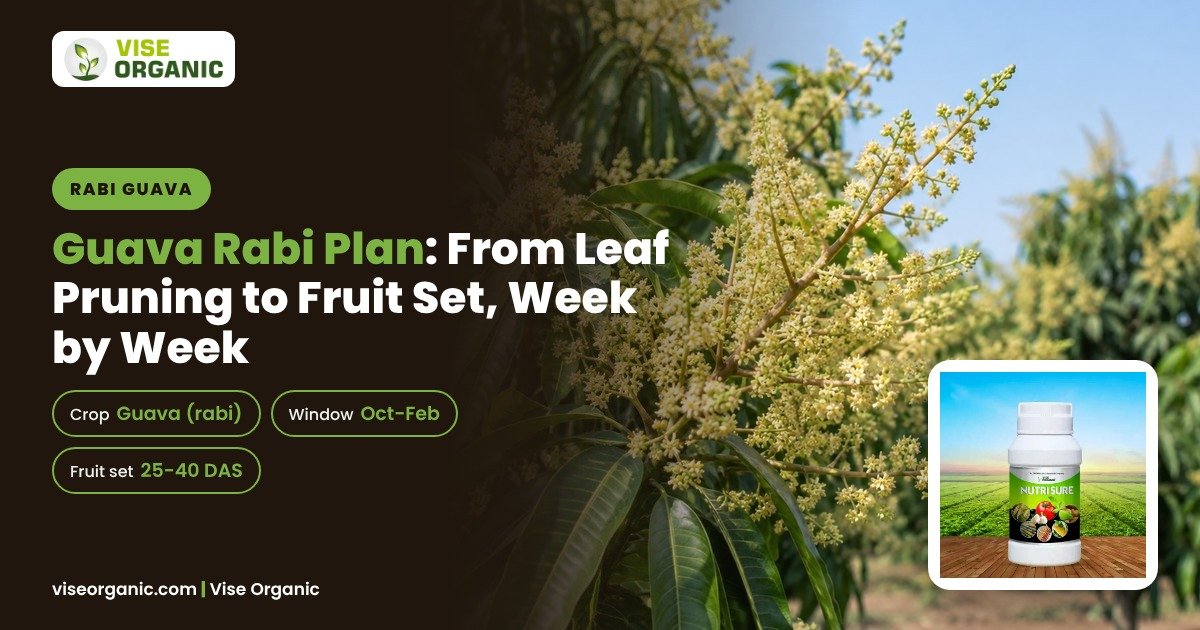
You prune the guava in June, water it through the monsoon, and then in the first week of November the trees look full of white flowers. Ten days later half those flowers are brown and on the ground, and the crop you counted on has gone. That gap between flowering and fruit set is where the rabi guava crop is won or lost, and it is mostly a timing question rather than a spray question.
This guava rabi plan walks the season week by week for 2026-27, from leaf pruning and flower induction to fruit set at 40 days after fruit set. It covers the nutrient and microbial side, the spray tank order, and the records a grower needs if the fruit is heading for an export channel under NPOP certification records.
Why Rabi Guava Fails at Flowering and Not at Harvest
Guava gives three crops a year in most of Gujarat, Maharashtra, Karnataka and Telangana: Mrig (June-July flowering), Hasth (August-September) and the rabi or "behan" crop that flowers after the October pruning and is harvested from February to April. The rabi crop usually pays best because fruit arrives when supply is thin, but it also carries the highest flower drop.
Three things drive that drop. First, the tree pushes leaves and flowers from the same flush at the same time, so young shoots compete with newly set fruit for carbohydrate. Second, day temperatures above 35°C at flowering and night temperatures below 12°C both disturb pollination and fruit attachment. Third, a tree carrying heavy leaves from the previous crop divides its food across too many sinks.
Say you grow three acres of Nafda or Lalguwa near Amreli on borewell irrigation. You prune in the first week of June, the trees flush through July and August, and you withhold water in late September to push flowering. If the October-November sprays reach the tree late by even ten days, the flowers open and fall before the fruit has attached. The whole plan below is built around hitting those windows.
Leaf Pruning and the Ten Days Before Flower Induction
Leaf pruning (removing leaves from the shoots that carry the fruit) is what makes the rabi crop synchronised instead of scattered. In most Gujarat and Maharashtra belts this is done 40-45 days after the June pruning, roughly mid to late September, when the new shoots have hardened and turned from bronze to dark green.
- Check shoot maturity. Rub a shoot between your fingers; a hardened shoot feels woody and a soft bronze one is not ready, and leaf pruning a soft shoot gives leaves instead of flowers.
- Pluck the basal leaves. Remove leaves from the lower two-thirds of each fruit-bearing shoot and leave the cluster of young leaves at the tip intact.
- Strip the water shoots. Cut suckers and vertical water shoots from the trunk and main branches so food is not diverted into vegetative growth.
- Clear the ground. Rake fallen leaves out of the basin and burn or compost them away from the orchard, because anthracnose spots over from old leaves.
Do not leaf prune a stressed or thirsty tree. Irrigate the day before, pluck on a dry morning, and hold off if rain is within 48 hours, since wounds on a wet canopy are where anthracnose enters.
Water Management From Withholding to Full Irrigation
Water is the switch that decides whether the pruned shoots carry flowers or leaves. Withholding after leaf pruning builds a mild moisture stress that pushes flowering; returning to full irrigation too early cancels that signal.
Withhold for 18-24 days after leaf pruning, watching the canopy rather than the calendar. Slight downward curling of the oldest leaves at midday is the sign you want. Then irrigate fully, and open the flowers usually appear in 8-15 days.
- Withholding phase. No irrigation, no heavy nitrogen, and no foliar urea, since nitrogen at this stage pulls the tree back into leaf.
- Irrigation restart. One full irrigation to field capacity once buds are visibly swollen, then light irrigations every 6-8 days depending on soil.
- Fruiting phase. Raise to 60-80 litres of water per tree per week for a mature tree in winter, more on sandy soil and less on heavy black cotton soil.
- Fruit development. Keep the interval steady. A dry spell followed by a heavy irrigation is a common cause of fruit cracking and later drop.
Avoid light frequent sprinkling through the whole cycle, because shallow roots make the tree far more sensitive to a two-day heat spell.
Flower Induction and Nutrient Support
Once buds are visible, the tree needs phosphorus and potash moving and micronutrients available at the flower. This is where the microbial and nutrition inputs fit, and where the same logic applies that we cover for grapes in Grape flower induction with GA3 and CPPU.
Phosphate solubilizing bacteria applied to the basin make locked soil phosphorus available to roots, which supports bud differentiation rather than leaf growth. Our PSB liquid is commonly used as a drench or basin application ahead of irrigation; follow the label rate on your pack and ask your KVK for the dose for your soil test report.
Potassium moves sugars into the developing fruit. Eco Root, a water-soluble potassium humate, is typically used as a drench or foliar spray at label strength during fruit development. For root and canopy establishment earlier in the year, Mycorrhiza 3000 IP is applied to the root zone at the pre-monsoon feeding, since a bigger root network is what carries a tree through a flowering heat spell.
Foliar nutrition at bud swell and at petal fall is where most growers see the difference. A balanced programme usually means a 5% urea or DAP spray at bud swell to open the flush, 15% ppm boron plus zinc before opening, and calcium at 0.2% from pea-sized fruit onwards. Where a specific product is used, follow that label rather than these figures.
Week-by-Week Spray and Feeding Schedule
The table below is the backbone of the season, counted from leaf pruning (day 0, usually mid-September) through to the first harvest in February. Every number in it is repeated in the notes that follow, so nothing is lost if you read this on your phone in the orchard.
[bar_chart] Guava Rabi Plan Activity by Stage | days after leaf pruning Leaf pruning | 0-5 | pluck basal leaves on hardened shoots Bud swell | 35-40 | restart irrigation and spray 5% urea Flowering | 45-55 | boron and zinc spray, no insecticide at open flower Fruit set | 55-65 | petal-fall nutrition and first calcium round Fruit development | 75-90 | potassium humate drench and calcium sprays Harvest begins | 130-145 | pick at full size with 40-45 days from fruit set
Read it as a schedule, not a rule. In South Gujarat leaf pruning can slip to early October and everything shifts right by two weeks. The stage, not the date, is what you spray against.
Fruit Set Sprays and the Tank Order
Fruit set in guava is a window of about 25-40 days after flowering starts, and the sprays that support it must land inside it. Spraying the same products a fortnight late mostly feeds new leaves, which then compete with the fruit you were trying to hold.
- Spray at bud swell. Target the swollen buds with the first flush spray so the leaves that open behind the flowers are already fed.
- Spray again at 50% flower opening. This is the boron and zinc round, aimed at pollen tube growth, and it must be a fine mist on the flower trusses.
- Spray at petal fall. The pea-sized fruit stage takes the first calcium round and any potash foliar feeding.
- Stop insecticides at open flower. Move pest control to the bud stage and after petal fall so the bees that set your fruit are not hit.
Tank order matters as much as timing. Fill the tank half with water, dissolve each product separately in a bucket of clean water before adding it, add micronutrient chelates first, then soluble nutrition, then botanicals, then the adjuvant last, and top up while stirring. Guava fruit set sprays work best at 400-500 litres of water per acre for a mature orchard with a spreader-sticker such as Plant Stick, because a waxy guava leaf sheds a plain spray droplet.
Do not tank-mix microbial products with chemical fungicides or bactericides unless the label says you may. Spray microbial inputs in the evening or before 9 am, and never in a tank that still holds a fungicide residue.
The 40-Day Rule After Fruit Set
The single most useful number in this plan is that guava fruit takes roughly 40-45 days from fruit set to reach harvestable maturity, and the tree decides whether to keep that fruit inside the first three to four weeks. Anything you want to do for fruit retention belongs in that early window, not after the fruit is already marble-sized.
Fruit drop shows in two distinct patterns. A heavy shed within 10-15 days of petal fall, where the fruit is yellow and hollow inside, points to poor pollination or a carbohydrate shortage. A later shed at marble size, where the fruit is healthy but the stalk is dry, points to moisture swings, nitrogen excess, or a thrips or fruit fly problem.
Count the drop yourself before you change anything. Tie a tag on ten fruit trusses, note the date of petal fall, and count how many are still on the tree at 21 days and at 40 days. Two counts like that tell you more than any single spray decision.
Nutrition From Pea Size to Harvest
Once fruit is set and retained, the demand shifts from flowers to filling the fruit. This is where a crop-specific programme earns its place, in the same way Nutri Wheat is timed to the grain-filling stage of wheat. For guava and most fruit crops, Nutri Sure is the general fruit-stage formulation used in this window; follow the label rate and the pre-harvest interval printed on the pack.
- Pea-sized fruit. Calcium nitrate or a calcium chelate at 0.2% reduces soft fruit and cracking, sprayed to run-off in the morning.
- Marble to egg size. Potassium humate drench in the basin plus a weekly foliar potash round supports colour and total solids.
- Colouring stage. Stop nitrogen completely. Nitrogen late in the season gives spongy fruit, poor colour and a shorter shelf life in the crate.
- Amino acid support. Uphar is typically used to help the tree recover canopy after a heat or stress spell; use it at the label rate and not as a substitute for the nutrition above.
Soil testing still outranks any spray schedule here. Get the basin tested once a year before leaf pruning and adjust potash and micronutrients to that report rather than to a neighbour's tank mix.
Pest and Disease Cover Inside the Flowering Window
Guava in rabi carries thrips and fruit fly pressure at flowering, and anthracnose and fruit rot in the wet part of the cycle. The timing rule is simple: protect the buds and the fruit after petal fall, and leave the open flower alone.
- Thrips at bud stage. Scrape a bud and tap it on white paper; silvering and twisting of young fruit are the signs. Botanical sprays belong here, before flowers open.
- Fruit fly from pea size. Install pheromone traps at 8-10 per acre before fruit reaches marble size and change lures every 4-6 weeks.
- Anthracnose after fruit set. Prune out spotted twigs and dried shoots into a bag, and keep the canopy open so sprays reach the fruit.
- Canker on wounds. Seal pruning cuts and never leave prunings lying under the trees through the season.
A full organic programme for a horticultural crop under a certification body is laid out in the Pomegranate flowering and fruit set plan, and the same input-selection logic applies to guava blocks.
Records for NPOP and Export Blocks
If your guava is going to a packhouse, an export house or a certification body, the spray schedule above is only half the file. The buyer's auditor will ask which inputs entered the block, when, at what dose, and what residues were tested.
Keep a register per block with the input name, batch number, date, dose per tree or per tank, and the operator's initials. Store inputs off the ground, away from sun and heat, and never in the same room as chemical pesticides. The NPOP input checklist for FPOs and export crops lists the documents to keep ready, and our NPOP compliance page explains what a certifier looks for. Growers supplying an export block should also read the Residue-free grape export plan for how pre-harvest intervals and harvest records are handled.
Spray against the stage you can see in the tree, not the date on the calendar, and the rabi guava crop holds its fruit.
Safety and Label Reading
Read the full label of every input before mixing, including the pre-harvest interval, and wear gloves and a mask while mixing and spraying. Do not tank-mix microbial products with chemical fungicides or bactericides unless the label permits it. Store packs away from direct sun and heat, above floor level, and locked away from children and animals. Keep mixing and rinsing water away from wells, ponds and canals, and never decant a product into a food container. Where an input is used on a certified organic block, the certifier's approved list decides what is allowed; check with them before you spray.
Frequently Asked Questions
When should leaf pruning be done for the rabi guava crop?
Usually 40-45 days after the June pruning, which falls in mid to late September in most of Gujarat and Maharashtra, later in South Gujarat. The shoots must be fully hardened and dark green; leaf pruning a soft bronze shoot produces leaves instead of flowers.
How many days after flowering is guava fruit ready to harvest?
Roughly 40-45 days from fruit set for most commercial varieties, so a tree that sets fruit in late November is picked from mid-January onwards. Variety and winter temperature shift this by one to two weeks.
Why do guava flowers fall without setting fruit?
Common causes are leaf and fruit competing for food in the same flush, day temperatures above 35°C or nights below 12°C at flowering, water stress during bud swell, excess nitrogen, and poor pollination because insecticide was sprayed on open flowers.
Is boron really needed at guava flowering?
Boron supports pollen tube growth and is one of the more consistent responses growers see at flowering, typically around 15 ppm as a fine mist at 50% flower opening. Confirm the rate on the product label and on your leaf or soil test before applying every season.
Can I spray insecticide when guava flowers are open?
Avoid it. Guava depends on bees and other visitors for good fruit set, so move pest management to the bud stage and after petal fall, and use pheromone traps and bait stations for fruit fly once fruit is pea-sized.
What is the 40-day rule in this guava rabi plan?
The tree decides whether to keep a fruit mostly within the first three to four weeks after set, and the fruit itself takes about 40-45 days to mature. All retention work, calcium, potash, steady irrigation and pest cover, belongs in that early window.
What records do I need for an NPOP certified guava block?
A block-wise input register with product name, batch number, date, dose and operator, along with field history, harvest and transport records, residue test reports and the certifier's approved input list. Keep the file per block, not per farm.
Conclusion
The guava rabi plan is really about three windows: leaf pruning on hardened shoots in September, water withheld and then restarted to force flowering, and every retention spray landed inside the first 25-40 days after flowering starts. Get the timing right and the tree holds fruit without heavy intervention; get it wrong and no amount of extra spray in January brings the flowers back.
Talk to our agronomists about the input programme for your block and season through Our products or Contact Vise Organic, or Request a callback for crop advice on pruning dates and fruit set nutrition.
Disclaimer: This article is general agronomic information. Results vary with soil, crop, weather and practices. Always read and follow the product label and consult a local agronomist for advice specific to your field.
Article Topics & Tags:
Vise Agronomy Team
The in-house agronomy and field research team at Vise Organic Biotechnology, publishing applied research on bio-fertilizer protocols, crop protection, and sustainable cultivation practices.