Walk into a rabi wheat field in the first week of January and two things can be going wrong at once. The upper leaves feel sticky and curl because a colony of aphids (phudda) is sitting on the leaf sheath, and the older leaves near the ground are dotted with small orange-brown blisters that rub off yellow on your thumb. One is an insect, the other a fungus, and most growers deal with both in a single tank because that is the easy thing to do. That single decision usually wastes the spray.
Getting wheat aphid leaf rust spray timing right means matching the spray to the growth stage and to what the scouting actually shows, not to the calendar date or to what the neighbour sprayed. This guide covers how to identify both problems in the field, the scouting counts that tell you when to act, which botanical and microbial sprays fit which stage, and how to build a tank that reaches the target.
Why Late Sprays Cost You More Than Wrong Products
Aphids in wheat feed on phloem sap, and the damage is not the leaf curl you see. It is the loss of grain filling that follows, plus the sooty mould (kali phusyi) that grows on the honeydew they drop on the flag leaf. A blackened flag leaf photosynthesises poorly through the grain-filling period, and that is exactly the window that decides grain weight.
Leaf rust (yellow rust, piliya rog) works differently. Each pustule produces spores that ride wind currents into the neighbouring rows, and the infection cycle repeats roughly every 10 to 14 days when nights are cool and dew sits on the leaves until mid-morning. A field where you see scattered pustules on lower leaves is early. A field where the flag leaf carries pustules is already past the point where any spray recovers the loss.
The reason timing matters so much is the overlap. Aphid populations in the plains usually build from late December into February, and rust becomes visible from late January onward in the same cool humid spells. The same weather that speeds up rust also favours aphid multiplication. You are watching two clocks that run together, which is why a fixed date-based spray schedule fails.
Reading the Field Before You Mix Anything
Scout twice a week in the same spots, walking a W pattern across the field so you cover the edges and the middle. Edges tell you first. Border rows along a field channel or a green potato strip usually carry aphids 7 to 10 days ahead of the interior, because the first colonisers land there.
Take ten random tillers per walk, check the underside of the newest fully open leaf and the leaf sheath below the boot, and count. For rust, look at three leaves per plant on ten plants: the lowest, the middle and the flag leaf. Record whether pustules are on the flag leaf or below it. That one detail decides your action.
Spray when the pest count crosses the action limit, not when you first see one insect or one pustule.
Scouting Thresholds and the Stage Map
The table below is the working reference for a normal rabi wheat crop sown in the first week of November in the north Indian plains. Shift the dates if your sowing was late, but keep the stage sequence the same.
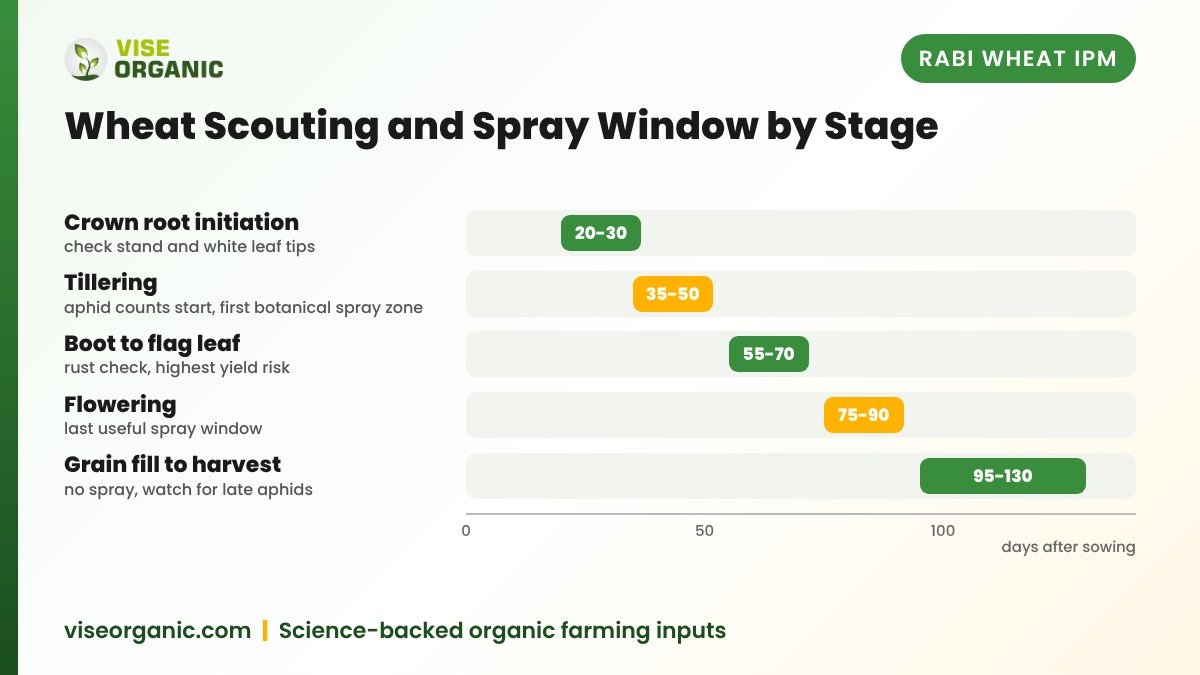
At crown root initiation you are looking for stand gaps and white tips that point to root or salt problems rather than pests. Tillering is where aphid counts start and where a well-timed botanical spray does the most good. Boot through flag leaf is the highest-risk window for both problems, since the flag leaf is doing most of the work for the coming grain. After flowering, a spray buys very little against aphids and only protects against a late rust flare on the flag leaf.
Botanical and Microbial Options by Stage
For aphids, contact action on soft-bodied insects comes from neem-based sprays (azadirachtin) and from insecticidal soaps or oils that break the waxy coating. These work on direct hit. They do not move into a curled leaf, which is why water volume and nozzle direction matter more than the product name. For a deeper look at mixing and coverage with neem, see How to use neem oil in organic farming.
Microbial biopesticides work on a different clock. A fungal or bacterial insecticide takes two to four days to knock down an aphid colony because the insect has to pick up the organism and die of the infection. That makes them a planning tool, not an emergency tool. Use them at the first sign of colonies so the population collapses before it doubles. Our Eco Cover is the botanical and microbial insecticide line we recommend for this, and Eco Safe covers the fungal side where leaf rust and related diseases need attention.
For rust, botanical fungicides based on neem, sulphur formulations permitted under your certification and certain microbial antagonists reduce spread. They suppress new infections. They do not remove pustules already on the leaf, and no spray brings back dead tissue. If rust is already on the flag leaf, plan for the season ahead: switch to a resistant variety and adjust your sowing date. For a comparison of what botanical disease sprays can and cannot do, see How Eco Safe contributes to pest and disease management in organic farming.
Seed and root protection sits under all of this. A healthy root system makes a crop tolerate insect feeding better, which is why many growers pair foliar protection with a good root zone program. Eco Root is the water-soluble potassium humate used at the tillering irrigation to support root growth and reduce the stress that makes fields attractive to sap suckers.
A Six-Step Field Routine
- Walk the field on a fixed day. Cover the border rows and the low wet patch first, since both show pests earliest, and note the growth stage you are in.
- Count before mixing. Ten tillers for aphids, three leaves on ten plants for rust, and write the numbers down so next week's count means something.
- Decide by the limit. Act on the count and the stage, not on the sight of one insect. Below the limit, do nothing and scout again in four days.
- Choose one target. If aphids are above limit and rust is only on lower leaves, aim the spray at the aphid and let the rust wait for its own trigger.
- Build the tank clean. Fill half with clean water, add the product, rinse the empty pack into the tank, then top up. Add a spreader sticker such as Plant Stick so the spray spreads on the waxy leaf.
- Aim at the target and stop. Point nozzles upward into the canopy for aphids on the sheath, use flat fan tips at low pressure to avoid drift, and end the spray before the tank runs dry chasing a few insects.
Doses and Water Volume by Stage
Follow the product label for every rate. The figures below are the typical published ranges used in rabi wheat for botanical sprays, stated as general guidance so you can plan tank sizes and labour. Confirm against your own label and check with your local KVK or agronomist before changing anything.
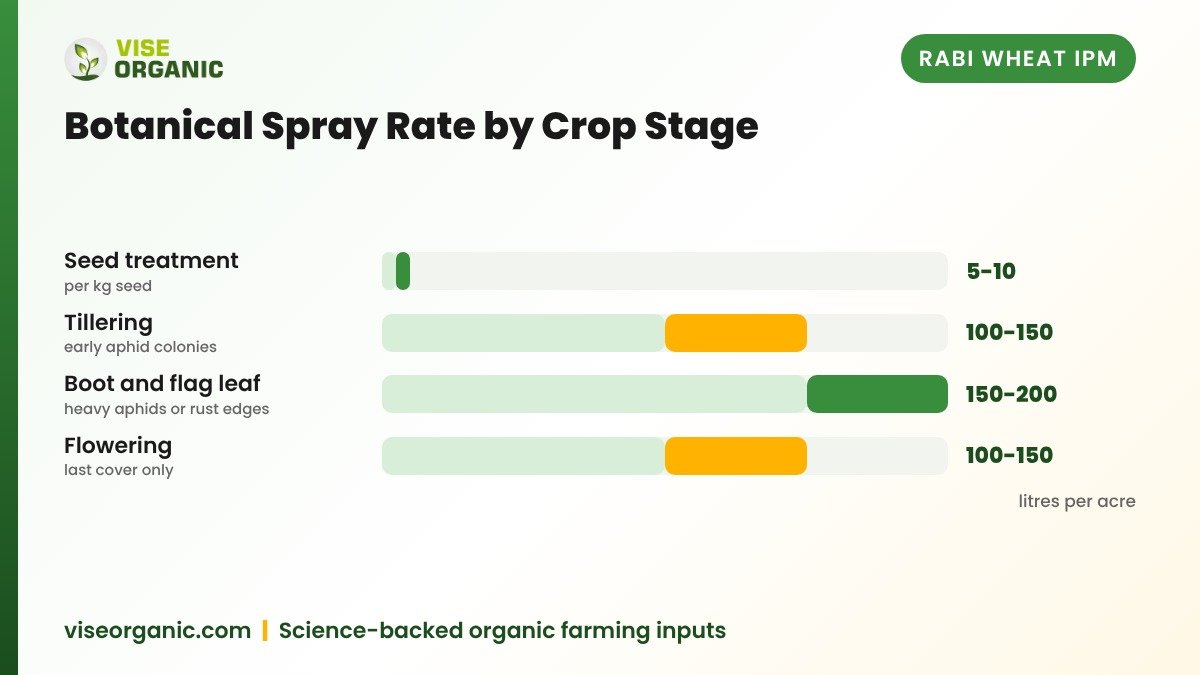
Water volume is where most wheat sprays fail. A crop at boot stage has a leaf area several times what it had at tillering, and 100 litres pushed through it leaves the lower canopy and the leaf sheath dry, which is exactly where aphids sit. Growers with 3 to 5 acres near Bharatpur or Meerut often run one pass with a knapsack at 150 to 200 litres per acre in the morning after the dew has dried, and that single pass, placed at the right stage, does more than three calendar sprays.
For nutrition support during grain filling, many growers add a crop-specific promoter such as Nutri Wheat as the label directs, separately from pest sprays rather than in the same tank, so you can see which one is doing the work.
Tank Mixes and Compatibility
The instinct to mix an insecticide and a fungicide in one tank saves one pass and can cost the whole spray. Microbial insecticides and fungicides are living formulations. They are generally not compatible with chemical fungicides or bactericides unless the label explicitly allows it, and alkaline mixes such as tank-mixed sulphur or copper will damage them within minutes.
- Read both labels. Look for a mixing statement and any restriction on pH or on chemical partners before combining anything.
- Test in a jar. Mix the actual rates in a clear jar of your field water and watch for thirty minutes for clumps, curdling or heat.
- Spray the test patch. Treat a few metres of rows, then check the plants after two days for leaf burn before covering the field.
- Never tank two microbial products with a chemical bactericide. Keep them in separate passes and leave a gap between them.
- Use clean water. Muddy or salty water reduces the performance of both botanical and microbial sprays, so fill from a clear source.
If you need two products, the safer plan is two passes with a gap of five to seven days, ordered by which problem is above its limit. For stage-by-stage spray logic on the same crop, see Our mustard IPM spray calendar as a worked example of the same method applied to another rabi crop.
Safety and Label
Read the full label before opening the pack, including the pre-harvest interval, which decides how close to harvest a spray can go. Wear gloves, a mask and full sleeves. Do not eat, drink or smoke while mixing. Wash the sprayer and your clothes away from any pond, well, canal or field channel, and never rinse leftover spray into standing water. Store packs in a cool dry place out of direct sun and heat, away from children and animal feed. Microbial products lose viability in hot stores, so keep them below 45 degrees Celsius and do not leave a pack in a closed vehicle. Use the mixed tank the same day.
What to Check Before Buying in Bulk
Dealers and FPOs buying for a whole cluster should verify the paperwork before the season starts, because a weak batch sprayed at the perfect stage still fails.
- Content and grade. Ask for the declared active content or microbial count on the pack and match it against the batch certificate for the lot you receive.
- Batch certificate and lab report. Every lot should carry a certificate of analysis with the batch number, test date and results, traceable to the pack in your hand.
- Registration. Check the registration number on the label against the central and state schedules that apply in your state.
- Packing condition. Sealed, undamaged packs with legible batch number, manufacturing date and expiry printed on the pack, not on a sticker.
- Shelf life and storage. Confirm the remaining shelf life is at least six months at delivery, and ask how the lot was stored in the warehouse. Heat damage kills microbial products before they reach your field.
- Field trial on your own crop. Buy one season's quantity for a demo block first and compare it against your current practice across a few acres.
Frequently Asked Questions
How many aphids on wheat mean I should spray?
In rabi wheat, a common working limit is around 5 to 10 aphids per tiller on a meaningful share of the plants examined, with colonies on the upper leaf sheath. Count ten tillers per walk and act on the average, not on the worst plant you find. Confirm the number you use with your local KVK, since limits shift with variety and stage.
Can I spray neem oil and a rust fungicide in the same tank?
Not as a rule. Botanical and microbial products are sensitive to pH and to chemical partners, and a wrong mix can inactivate the microbial part within minutes. If you need both, read both labels, do a jar test, and preferably make two passes five to seven days apart, starting with whichever problem is above its limit.
Will a fungicide clear leaf rust already on the flag leaf?
No. Foliar sprays suppress new infections and slow spread to neighbouring plants. Pustules already on the leaf and the dead tissue around them stay there. Once the flag leaf is heavily infected, your return comes from choosing a resistant variety and an earlier sowing date next season.
Which growth stage is most worth protecting in wheat?
Boot through flag leaf, roughly 55 to 70 days after sowing for a November-sown crop in the plains. The flag leaf contributes most of the photosynthesis that fills the grain, so keeping it clean of aphid colonies and fresh rust pustules protects the yield you are still building.
How much water should I use per acre for a wheat spray?
Typically 100 to 150 litres per acre at tillering and 150 to 200 litres per acre from boot stage onward, with the exact figure on your product label. Coverage beats concentration. Point nozzles upward into the canopy so the leaf sheath where aphids sit actually gets wet.
What is the best time of day to spray rabi wheat?
Early morning after the dew has dried, or late afternoon when the temperature drops and the wind is still. Aphids shelter on the shaded underside and in the sheath, and a hot midday spray dries on the nozzle before it reaches them. Never spray when a breeze carries drift to a neighbour's field.
Are these sprays allowed on certified organic wheat?
What is allowed on a certified farm is decided by your certifier and the NPOP schedule for your state, not by a product claim. Check the registration status of the specific product with your certifier before applying, and keep the purchase and application records your certification audit will ask for.
Conclusion
Aphids and leaf rust attack the same crop for the same reason, cool weather with moisture on the leaf, and they are handled by the same habit: scout on a fixed day, act on a count, and place the spray at tillering to boot stage when the flag leaf still has work to do. Good wheat aphid leaf rust spray timing is mostly patience plus a notebook, and it saves passes rather than promising results. Outcomes always depend on your soil, variety, weather and how well the spray actually lands on the target.
Talk to our team about a season plan for your block, or browse Our products for the full range, and Contact Vise Organic or Request a callback for crop advice from an agronomist.
Disclaimer: This article is general agronomic information. Results vary with soil, crop, weather and practices. Always read and follow the product label and consult a local agronomist for advice specific to your field.
Article Topics & Tags:
Vise Agronomy Team
The in-house agronomy and field research team at Vise Organic Biotechnology, publishing applied research on bio-fertilizer protocols, crop protection, and sustainable cultivation practices.