
Standing in a wheat field in the first week of January, you can usually tell what happened below the surface without digging. Tillers are thick and uneven, some plants have four or five shoots, others have two, and the leaves carry a pale yellow edge. Frost nights and a cold soil that slowed root growth are often the reason. That is where Seaweed extract on rabi wheat earns its place in the plan, not as a substitute for your nitrogen or farmyard manure, but as a steady input that helps the crop handle cold snaps, salt and the rush of demand at grain fill.
This guide covers one crop and one season: wheat sown in October and standing through February-March 2027. You get the spray stages with the days after sowing, the typical dilution, how to combine it with humate, PSB and KMB, and the tank mix rules that decide whether the spray does any good at all.
What Seaweed Extract Actually Does in a Wheat Crop
Seaweed extract is made from brown seaweeds, mostly Ascophyllum nodosum, cold-pressed or enzyme-extracted so the natural compounds survive. It supplies a small amount of potash and micronutrients, plus alginates, mannitol and traces of natural growth substances.
In wheat, those pieces work in plain, unglamorous ways. Alginates feed soil microbes and help bind soil particles into small aggregates, so water and air move better around the roots. Mannitol helps the plant hold water when the wind is dry and the nights are cold. The trace growth substances push root branching, which is why plants treated early often stand up better after a frost.
It is a plant growth promoter, not a nutrient bag and not a pesticide. Wheat still needs its nitrogen, phosphorus and potash from manure, biofertilizers and soil test based doses. What seaweed changes is how well the crop uses what you already gave it, and how fast it recovers after stress. Results depend on your soil, variety, weather and how evenly you spray.
The Three Spray Stages That Matter
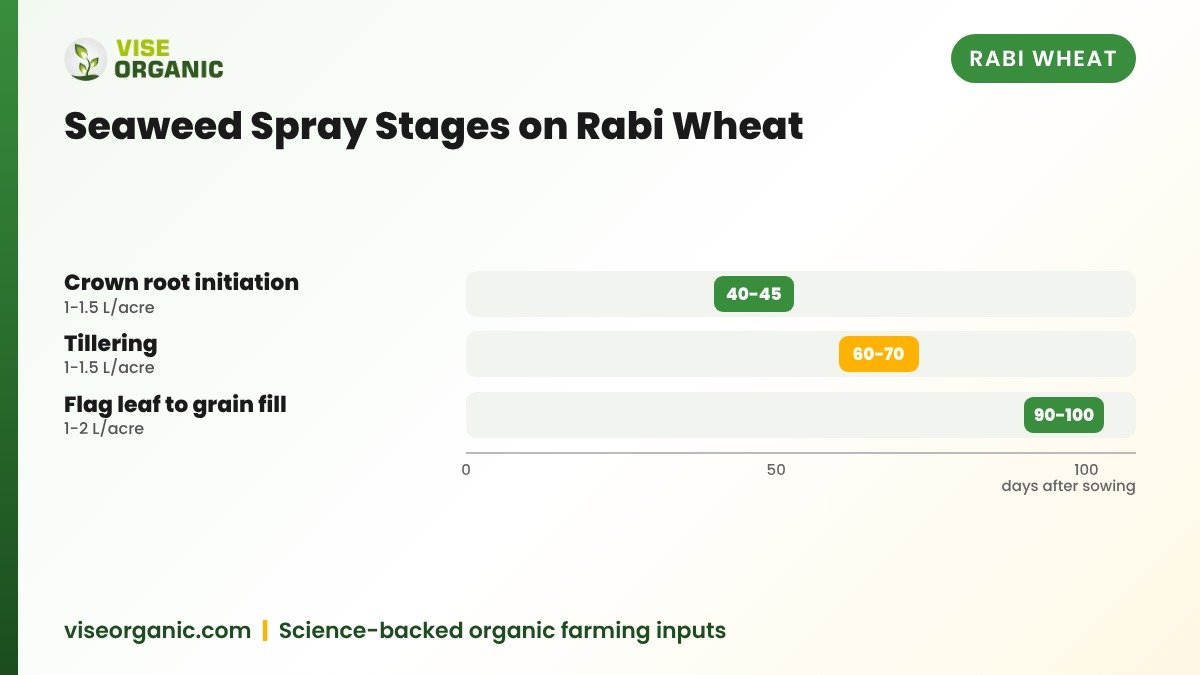
Timing carries more weight than dose in a seaweed program. Three sprays fit a normal rabi wheat crop, and each one answers a different problem.
Say you grow 3 acres of a medium-duration wheat near Bharatpur on flood irrigation, sown on 28 October. Crown root initiation lands around the third week of December, tillering peaks in January, and the flag leaf and grain fill run through February into early March. That calendar gives you the three slots below.
The first spray at crown root initiation is the one most farmers skip and the one that pays back most, because it works on the root system before the cold hits. The second at tillering supports the shoots that will carry grain. The third at flag leaf to early grain fill supports the grain-filling period, when the plant is moving sugars into the head.
Spray in the morning after the dew dries, before 10 am, or after 4 pm. A cold, still morning with heavy dew means the spray sits wet too long and gets less uptake.
Seed Treatment or Root Dip First
A seaweed drench at sowing gives the young roots a start before the first spray is even possible. Two methods work in wheat.
- Seed treatment. Mix the recommended label quantity of liquid seaweed extract with sufficient water for your seed lot, coat evenly in a drum or on a tarpaulin, and dry in shade for 20-30 minutes before sowing. Do this after your Biofertilizer seed treatment for rabi crops, never mixed in the same bucket with the culture.
- Nursery or root dip drench. Where you transplant rice seedlings into a wheat-paddy zone, dip the roots in the diluted solution for a few minutes before planting. Skip this for direct-seeded wheat.
- Furrow application. In rows spaced 20-22 cm, apply the diluted solution along the furrow at sowing with a can or a fertigation line, then cover with the row opener.
Seed treatment suits farmers who want one less tank to fill. Furrow application suits a field with poor germination patches, because it hits the emerging radicle directly. Foliar sprays at the three stages above do the visible work; the sowing-stage application is the quiet foundation.
Pairing Seaweed With Humate and Your Biofertilizers
Seaweed and humic acid do different jobs and cover each other's gaps nicely. Humate works mostly below, on soil organic carbon and cation exchange, while seaweed works mostly on the leaf and the root tip. Used together they are a sensible soil-plus-crop pair rather than two competing products.
- Soil first, foliar later. Work Eco Granule humic granules into the field at the last plough or with the basal dose, then keep the seaweed for foliar sprays at the three stages.
- Seaweed with a liquid humate. Where you prefer a liquid, Eco Root potassium humate goes into the same tank as seaweed in most cases. Dissolve each separately in water before adding both to the full tank.
- Keep microbes separate. Do not run seaweed extract in the same tank as a microbial biofertilizer spray unless the label allows it. Apply your PSB and KMB plan separately to the soil, and let seaweed stay on the leaf.
- Do not chase the potash number. Seaweed carries some potash, but it is not a potash replacement on a sandy wheat field that needs its full graded dose.
For soil organic carbon, the seaweed and humate pair is a support, not the main lever. The bulk of carbon comes from root mass, residue and well-rotted manure, and you can read the numbers in our guide to Soil organic carbon for rabi wheat.
Tank Mix Rules and What Not to Mix
Most seaweed sprays fail in the tank, not in the field. Wheat farmers often want to mix everything into one pass, and that is where the product gets ruined.
- Fill the tank half with clean water first. Add each product only after the previous one is fully dispersed in that water.
- Use the jar test. Mix the planned rates of both products in a jar of your field water and leave it 15 minutes. Cloudiness, curds, foam or sediment at the bottom means do not tank mix.
- Add a spreader. Seaweed solutions spread poorly on waxy wheat leaves. Silk or Plant Stick as a spread sticker gives better coverage on the leaf sheath.
- Check the water. Hard water with high bicarbonates drops the effectiveness of any foliar input. Clean water at a neutral to slightly acidic pH works best, and you can check your source against our note on Irrigation water quality and biofertilizers.
- Spray separately from strong chemistry. Keep microbial products and seaweed sprays at least 5 to 7 days apart from any chemical fungicide or bactericide drench.
- Clean the tank before you fill. Residue of a copper or strong alkaline spray from the previous pass will spoil a seaweed tank. Do not spray into hot dry afternoon air, and do not spray a crop already moisture stressed at midday.
A seaweed spray you cannot jar test is a seaweed spray you are gambling on.
How to Judge Whether It Worked
Do not judge a seaweed program by the look of a leaf three days after spraying. Judge it on roots, uniformity and the grain at harvest.
- Root check at 20 to 25 days after the first spray. Dig two or three plants with soil intact and look for more white root hairs and deeper crown roots than the unsprayed strip.
- Tiller count. Tag ten plants and count tillers on the same plants twice, before and 20 days after the tillering spray.
- Field uniformity. Walk the field at flag leaf. A good program shows up as an even head emergence date across the field, not as unusually tall plants.
- Harvest comparison. Leave an unsprayed strip of a quarter acre along the same soil type, and compare the cleaned grain weight from that strip against the rest of the field.
Expect differences in standability, uniformity and recovery after stress. Do not expect a fixed number. Trials vary with soil, variety, weather and how evenly your nozzle delivers, and no honest program can promise a figure in advance.
Buying Seaweed Extract in Bulk
Dealers and FPOs buying by the drum should check a few things before the truck is loaded, because seaweed products vary more than any other input on the shelf.
- Ask for the source and method. Name of the seaweed species and whether it is cold pressed, enzyme extracted or alkaline hydrolysed. Alkaline hydrolysis destroys much of what you are paying for.
- Ask for the analysis. Potash percentage, pH of the diluted solution, and the label's claim on auxin or cytokinin activity if any is made.
- Check the batch documents. Batch number, manufacturing date, expiry and a certificate of analysis for the lot you are receiving.
- Check the packing. Sealed HDPE with a liner, no bulging drums, no crystallised residue at the cap. Light and heat degrade the actives.
- Run a field trial before you stock it. Buy one drum, spray two acres, leave a strip unsprayed and compare the roots at 25 days.
Store stock in a shaded, ventilated room below 35 degrees Celsius, off the floor on a pallet, away from children and away from any chemical store. Shelf life on a well-sealed bottle is usually around two years; check the label and follow the printed date. Our Research and development page explains how Vise Organic tests its formulations, and you can see the full range in Our shop.
Safety and Label Reading
Read the full label before the first spray, including the dilution table, the crop list and the re-entry interval. Wear gloves, a mask and full sleeves while measuring and spraying, and wash hands and face before eating or smoking.
Never drink or taste a seaweed solution to judge its strength, and never decant concentrate into a bottle that held drinking water. Keep the spray area away from ponds, canals and wells used for drinking. Store the container tightly closed in shade, away from heat and out of children's reach. If a label lists a compatibility restriction, that restriction wins over any advice in this article, including our own.
Frequently Asked Questions
Can I spray seaweed extract on wheat during a frost warning?
Spray before the cold spell, not during it. A seaweed spray 2 to 3 days ahead of a frost helps the plant hold water and recover faster. Spraying on a frozen or heavily frost-damaged crop wastes product.
How many seaweed sprays does rabi wheat need?
Three sprays are enough for a normal crop: crown root initiation at 40 to 45 days after sowing, tillering at 60 to 70 days, and flag leaf to early grain fill at 90 to 100 days. A fourth spray rarely adds anything if the first three were timed right.
Can I mix seaweed extract with urea in the same tank?
Many farmers add 1 to 2 percent grade urea to a seaweed spray and it works, but run a jar test first with your own water. High bicarbonate water plus a heavy salt load can drop the effectiveness of the seaweed solution.
Is seaweed extract the same as compost or farmyard manure?
No. Compost and manure feed soil organic carbon and microbial mass in bulk. Seaweed extract is a concentrated foliar and root input that supports growth and stress handling. Use both for their own jobs, and see our guide to [compost maturity for soil health](/compost-maturity-for-soil-health-farmers-guide) for the manure side.
Does seaweed extract replace my PSB or KMB application?
No. PSB works on bound phosphorus and KMB works on potash availability in the soil. Seaweed does not do either job. Keep your soil biofertilizer schedule, and read [how to evaluate biofertilizer performance](/how-to-evaluate-biofertilizer-performance) to check that schedule.
What is the best time of day to spray seaweed extract on wheat?
Early morning after the dew dries, before 10 am, or late afternoon after 4 pm. Avoid the hot midday hours and avoid spraying into strong wind, since wheat leaves are waxy and the solution needs time to stay wet on the leaf.
Will seaweed extract fix yellow leaf tips in my wheat?
Not always. Yellow tips point to a nitrogen shortage, waterlogging, salt or root damage. Check the cause first with a [soil test before you apply biofertilizers](/soil-testing-before-biofertilizers), then treat the shortage. Seaweed supports recovery once the real cause is handled.
Conclusion
Seaweed extract on rabi wheat works best as a small, timed program: one soil or seed application at sowing, then sprays at crown root initiation around 40 to 45 days, at tillering around 60 to 70 days, and at flag leaf to grain fill around 90 to 100 days, with humate and your biofertilizers doing the soil side of the job. Keep the tank mix clean, judge the crop on roots and uniformity rather than leaf colour, and let the label set your dose.
Start with two acres this season, leave an unsprayed strip, and dig a few plants at 25 days so you have your own numbers before you commit the whole farm. Browse Our products or Contact Vise Organic to talk to our team, and Request a callback for crop advice on your own field.
Disclaimer: This article is general agronomic information. Results vary with soil, crop, weather and practices. Always read and follow the product label and consult a local agronomist for advice specific to your field.
Article Topics & Tags:
Vise Agronomy Team
The in-house agronomy and field research team at Vise Organic Biotechnology, publishing applied research on bio-fertilizer protocols, crop protection, and sustainable cultivation practices.