Cold December mornings in Bharatpur or Kota feel calm, but that is exactly when mustard aphids quietly build up. You walk past the crop and everything looks fine, then you run a finger along a young leaf and it comes away sticky. By the time the sticks and sooty mould show up, the sap has already gone somewhere you cannot get back.
Getting the neem oil spray for mustard aphids right is mostly a matter of timing and tank mixing, not of increasing the dose. This guide covers how to tell an aphid problem early, when to spray on rabi mustard, how to mix neem oil in the knapsack, and how to fit botanical and microbial sprays into a simple IPM calendar for your field.
Why Aphids Build Up in Rabi Mustard
Aphids (madua) multiply fastest when nights are cool and days are dry, which is exactly the weather most rabi mustard gets between late December and February. Sap-feeding colonies start on the underside of young leaves and on the growing tip, then move up to the buds and the developing pods.
Honeydew from the feeding drops on the leaves below and turns black with sooty mould, which cuts the green area that is still filling your pods. Ants farming the aphids for that honeydew make the colony harder to disturb. Stress from a dry spell or from excess urea makes the soft growth more attractive, so the same variety in a manured, irrigated field often holds up better than a lush, over-fed one.
Field Check That Decides Your Spray Date
Do the check properly and you will rarely spray too early. Walk a W route across the field, stopping at ten to fifteen spots, and look at the underside of the top three fully open leaves on five plants in each spot.
- Count the colonies. Note how many of your plants carry aphids and how many of those are on the tip or the bud, not just on old lower leaves.
- Look for the good guys. Ladybird beetles, lacewing larvae and small parasitised wasps working on the crop are worth protecting, and their presence changes what you spray.
- Check the damage type. Sticky honeydew, black sooty mould, curling young leaves and a sticky feel on your hand are the signs; yellowing of lower leaves is usually something else.
- Note the weather. A warm, dry spell with light wind pushes multiplication up, while rain knocks colonies down and usually buys you a week.
Spraying on a fixed calendar date, with no field check, is the most common way to waste money and blow up the natural enemies that were holding the aphids down.
Spray Stage and Timing on Mustard
Mustard can put on new buds and branches after a spray, so the stage matters more than the insect count. The bud to early flowering stage is the window where colonies do the most long-term damage, and the same window is also when the crop is most sensitive to a harsh spray.
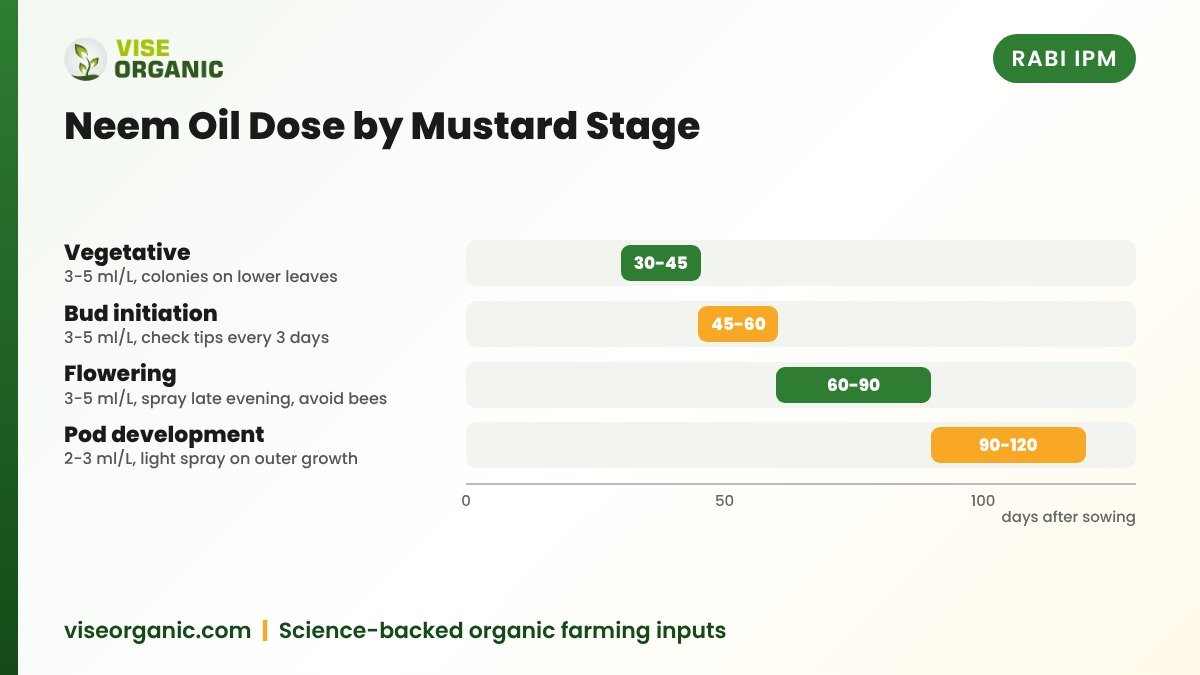
Read the label on your bottle before every tank. Cold-pressed neem oil and standardized azadirachtin products are not the same strength, so the label rate on your pack always beats any general figure. The lower dose at the pod stage is because the crop is closer to harvest and the colonies are usually on the outer growth where a lighter spray reaches them.
Two more timing rules matter as much as the dose. Spray in the early morning after the dew dries or in the late evening, never in the heat of the day, because neem works largely by contact and by residue and heat drives the volatile part off quickly. Avoid flowering peak hours when bees are working the crop, which in rabi usually means skipping 10 am to 3 pm.
How to Mix and Apply the Spray
Neem oil will not mix into plain water on its own, and a badly mixed tank gives you oily patches and missed aphids in the same field.
- Fill the tank half. Take clean water and fill the knapsack or power sprayer halfway, ideally from a source that is not muddy or hard.
- Mix the emulsifier. Take the neem oil in a small bucket, add the recommended emulsifier or a few drops of a spreader sticker such as Silk, and stir it into a milky paste before adding water.
- Add to the tank. Pour the milky mix into the half-filled tank and stir, then top up to the full volume. Never pour crude oil straight into a full tank.
- Strain and test. Strain the mix through a cloth into the tank and check the nozzle pattern on a bundle of leaves before you start the row.
- Cover the underside. Walk the boom or wand so the spray reaches the underside of leaves and the growing tip. Aphids sit there, and a top-only spray misses most of the colony.
- Clean the tank. Wash the sprayer and rinse the filter at the end so oil does not build up and block the nozzle for the next job.
A typical rabi field of 5 to 7.5 litres of water per acre is normal for a knapsack on standing mustard. Use a flat or hollow-cone nozzle at moderate pressure rather than a fine high-pressure mist, which drifts off the waxy leaf.
Spray the underside of the leaf, not the top of the crop, and spray before the honeydew turns black.
Botanical and Microbial Options in One Schedule
Neem is your main contact option, but a rabi field usually needs more than one tool across February and March. Botanical and microbial sprays work slowly compared with a chemical knockdown, so they fit best when you start on a young colony and keep the natural enemies alive.
| Product Type | What It Does in the Field | Typical Use |
|---|---|---|
| Neem oil / azadirachtin | Contact and residue action, deters feeding and disrupts moulting | At first colonies, repeat after 7-10 days if needed |
| Beauveria or botanical fungal spray | Infects soft-bodied insects in humid weather | Aphid build-up with cool humid spells |
| Eco Cover | Botanical pesticide for chewing and sucking pests in an IPM plan | As per label, alternate with neem |
| Eco Safe | Botanical fungicide for the mildew that follows stressed growth | Where mildew joins the aphid damage |
| Plant Stick | Spreaders and stickers that improve coverage on waxy mustard leaves | With any spray for better coverage |
Alternate the mode of action rather than the brand. If you spray neem twice in ten days and the colony survives, a different product class plus a quick look at what went wrong (dose, mixing, coverage, timing) is a better answer than a third neem spray. Where aphids are heavy and the crop is still making buds, a nutritional push with a crop-specific PGR such as Nutri Wheat or a seaweed extract helps the plant recover its growing points; see the Rabi mustard care guide for that side of the plan.
What to Check Before Buying in Bulk
Dealers and FPOs buying neem or botanical sprays for a season should treat the pack as a specification, not a brand name.
- Ask for the azadirachtin content. A 1500 ppm azadirachtin product and a crude cold-pressed oil are not dosed the same way, so confirm the declared content and match your tank mix to it.
- Check the batch paperwork. Batch number, manufacturing date, expiry and the certificate of analysis for that batch, matched to the drums you actually receive.
- Look at the packing. Dark, sealed containers with a tamper band. Neem degrades in heat and sunlight, and a drum that has sat in a hot godown all summer loses strength.
- Test shelf life in your own store. Draw a small sample, mix a litre and see whether it emulsifies into a milky white or separates into oil patches. Separation is your warning sign.
- Store it properly. Keep stock cool, dark and dry, away from direct sun and away from any chemical bactericide or fungicide shelf, and off the floor on pallets.
Safety and Label Reading
Neem is low in toxicity to humans compared with many synthetics, but it is still a pesticide and hot oil in a tank will irritate skin and eyes. Wear gloves, a mask and full sleeves, keep your face out of the spray cloud, and wash hands and clothes after the job. Do not mix microbial products with chemical fungicides or bactericides in the same tank unless the label clearly allows it, and never spray into a pond, canal or well. Keep packs locked away from children and away from food. Read the whole label on every new pack, since rates differ between formulations.
Related reads: Mustard ipm spray calendar, Mustard aphid control spray timing
Frequently Asked Questions
How much neem oil per litre should I spray on mustard for aphids?
As a general published range, 3 to 5 ml per litre on vegetative to flowering mustard and about 2 to 3 ml per litre at the pod stage, always matched to the rate printed on your pack since azadirachtin strength varies between products.
When is the right stage to spray neem oil on mustard?
The bud to early flowering stage is the most damage-sensitive window, but spray only after a field check shows colonies on the tips or buds. Early morning after the dew dries or late evening works better than midday heat.
Can I mix neem oil with a microbial biopesticide in the same tank?
Do a jar test first and follow both labels. Neem's contact and antifungal action can harm microbial formulations, so many growers spray them a few days apart instead of mixing, and use a spreader sticker in the neem tank for coverage.
Why are aphids coming back after two or three days of my spray?
Neem is largely a contact and residue product, so missed colonies under leaves and fresh growth after the spray both cause a rebound. Check coverage of the leaf underside, the tank mixing and whether new hatching is happening, and only then consider a second spray after 7 to 10 days.
Will spraying neem oil harm ladybirds and bees in my mustard field?
Neem is less harsh on many beneficials than a broad chemical, but direct contact spray on insects still hurts them. Spray when bees are not working the flowers, avoid midday hours, and if ladybirds and lacewings are active in the field, hold off on a broad spray and monitor.
What else should I do besides spraying to keep aphids down in rabi mustard?
Avoid excess urea and late nitrogen, keep the field weed-free around bunds, irrigate during dry spells so the crop is not stressed, grow resistant varieties where available, and rely on ladybirds and parasitoid wasps before reaching for the sprayer.
How do I tell aphid damage from a nutrient problem on mustard leaves?
Aphid damage comes with sticky honeydew, black sooty mould, and colonies you can see on the underside of the leaf and the growing tip. Nutrient yellowing usually starts on older lower leaves, is even across the leaf, and has no insects or stickiness.
Conclusion
Mustard aphids cost you sap, pod set and grain filling, but the loss is mostly decided by whether you catch the colony early and spray the underside of the leaves at the bud to pod stage with a properly mixed tank. A neem oil spray for mustard aphids works best at 3 to 5 ml per litre as a general guide, repeated only after a real field check, and paired with natural enemies, a spreader sticker and good nutrition. For a season plan built around your own field, walk through our Range of products or Contact Vise Organic for crop advice and dealer support.
Disclaimer: This article is general agronomic information. Results vary with soil, crop, weather and practices. Always read and follow the product label and consult a local agronomist for advice specific to your field.
Article Topics & Tags:
Vise Agronomy Team
The in-house agronomy and field research team at Vise Organic Biotechnology, publishing applied research on bio-fertilizer protocols, crop protection, and sustainable cultivation practices.