You spray boron on time, the first flowers look promising, and ten days later the lower clusters are lying on the ground while the upper ones hang thin. In the guar belt of Rajasthan, and in the marginal strips of Haryana, Punjab and Gujarat, that picture repeats every rabi, and most farmers blame the weather for all of it. Heat at flowering, dry winds and a boron shortage all push the same way, and only one of them you can do something about.
This guide covers the in-season plan for guar cluster drop (ganthi girna, phool jhadna): when to dig and count root nodules, the boron and molybdenum spray timings that actually matter, and how to tell a nutrient gap apart from a heat day. It follows the crop from sowing to the first harvest, day 30 to day 115.
Why Guar Clusters Fall Off in Rabi
Guar sets its pods on clusters (ganthi) that carry flowers over several days, and the plant abandons the youngest of them the moment its own sugar supply falls short. Say you grow four acres of guar near Degana on unirrigated land and a dry, hot wind blows for three days at first flowering. The plant closes its leaf pores to save water, photosynthesis slows, and the developing clusters are the first thing it drops.
Three causes run together in most fields.
- Heat and dry wind. Temperatures above 38°C at flowering, or a hot dry wind for two to three days, set the whole crop back at once and no spray can undo that day.
- Boron shortage. Boron moves with water in the soil and is leached out of sandy soils low in organic matter, so the tip growth and pollen tubes starve first and the cluster aborts.
- Weak nitrogen supply. Guar feeds itself through Rhizobium nodules, and when those nodules are few or grey the plant runs short of nitrogen at exactly the stage when it is filling pods.
Waterlogging and a heavy dose of uncomposted farm waste belong on the same list. Root damage from either one shows up as yellowing and drop two weeks later, not on the day it happened.
Check Nodules Before You Chase the Drop
Before you spend money on a spray, dig one plant and look at its roots. A healthy guar plant at day 30 to 35 carries 6 to 8 active nodules (root granules, jaivik ganthi) on the main root and laterals, pink or salmon when you cut one open. Fewer than 4, or nodules that are white or grey inside, means the nitrogen engine is not running and no amount of boron will hold the clusters.
Dig 5 plants at random from three spots, wash the roots in a bucket of water rather than pulling them out dry, and cut the nodules open with a blade on a white sheet. Pink inside means active. Green-tinged nodules on stems or leaf stalks are not nitrogen nodules; leave them alone.
Seed Treatment Sets the Ceiling
Cluster hold starts 40 days before the first flower, at sowing. Rhizobium for guar needs the right strain and it needs shade, because direct sun on the treated seed kills the cells within minutes. Mix the recommended dose of Rhizobium liquid biofertilizer with a sticker on the seed, dry it in shade for two to three hours, and treat the seed the same day.
Two habits ruin a good treatment. One, broadcasting a biofertilizer into dry dust and expecting nodulation in a soil at 30°C. Two, mixing the microbial seed treatment in the same tank as a chemical fungicide or bactericide, which the label does not allow. If a fungicide is required, treat with it first, dry the seed, then treat with the biofertilizer separately. A PSB biofertilizer works well in the same seed line for phosphorus that is locked up in your soil, and a phosphate-solubilizing KMB multiplier supports the potash side that pod fill leans on.
The Spray Calendar That Holds Clusters
Sprays in guar do one job: fill the gap the soil cannot fill during the two weeks when the plant is flowering and setting pods. Everything else is a bonus. Two boron sprays, at first flower and again at pod set, cover the two windows where a boron-starved plant drops its clusters.
Follow the label on whatever micro-nutrient product you buy, since boron products vary widely in strength, and treat the rates below as the published ranges Indian advisers usually quote for guar per acre.
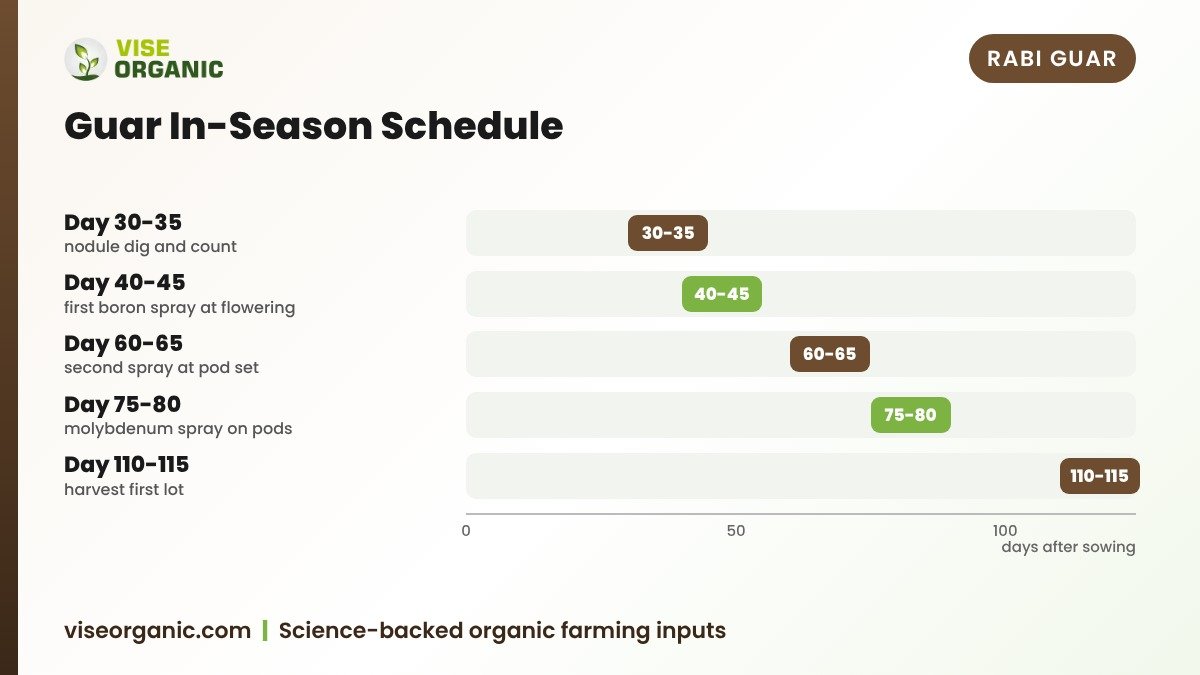
- Day 30 to 35, dig and count. Pull 5 plants from three spots and count pink nodules. Under 4 per plant is a nodule problem, not a spray problem.
- Day 40 to 45, first boron spray. Spray at first flowering, when 10 to 15% of the plants have opened flowers, in the cool part of the morning.
- Day 60 to 65, second boron spray. Repeat at pod set, when the young pods are 1 to 2 cm long, on the same cool-morning rule.
- Day 75 to 80, molybdenum on the pods. Spray sodium molybdate late in the afternoon; molybdenum runs the nitrogen enzyme inside the nodule and the leaf.
- Day 110 to 115, harvest the first lot. Pick before the pods turn fibrous and let the upper clusters keep filling.
A seaweed extract spray such as Seacure liquid at the pod set stage helps the plant ride out a heat spell, and a potassium humate like Eco Root keeps the root zone open in sandy soils. For a rabi cereal crop in the same rotation, the stage-by-stage logic is the same as in our Rabi wheat flowering and grain fill plan.
[timeline_chart] Guar In-Season Schedule | days after sowing Day 30-35 | 30-35 | nodule dig and count Day 40-45 | 40-45 | first boron spray at flowering Day 60-65 | 60-65 | second spray at pod set Day 75-80 | 75-80 | molybdenum spray on pods Day 110-115 | 110-115 | harvest first lot
Boron Rates: Start Low, Never Guess
Boron sits on a narrow line between a deficiency and a damage, and guar fields differ in how much they need. A field that has responded to boron for years needs far less than a new field on fresh sandy soil.
Half the field on the lower rate, half on the higher one, and let your own field decide the dose for next year.
Split the dose across the two sprays rather than putting it all in one tank. Never apply boron to a drought-stressed field just before a hot afternoon, and never broadcast boron powder by hand on a windy day; banded or foliar placement is far safer. Leaf tip yellowing and a burnt margin on the youngest leaves after a spray means you went over, and the fix is to stop and irrigate if the crop can take it.
Feeding the Plant Without Forcing It
Guar does not want a heavy nitrogen push. A forced nitrogen dose suppresses the nodules, the plant stops paying for its own nitrogen supply, and the crop grows leafy at the cost of pods. The safer route is to keep the nodules working and support the plant with carbon and mild growth promoters.
- Work organic matter in. Composted cow dung manure (gaiber) or a humic product such as Eco Green holds moisture in sandy soils and gives the microbes food.
- Use a crop-specific promoter. A wheat and rabi cereal line like Nutri Wheat suits the cereal crop in your rotation; for guar, follow the label for pulse crops and ask our team for the right fit.
- Keep the soil carbon alive. A carbon-focused soil input such as Soil Carbone pays back across the rotation rather than in one season.
For the soil-building side of a rabi field, our guide to Soil organic carbon in rabi wheat with compost and humate applies to guar ground in the same way.
If Guar Is Going for Export or Certification
A guar lot meant for the export trade or for a certified organic block is judged on records, not on the crop in front of the inspector. Input register, spray dates, product labels kept, and an input list approved by your certifier carry the inspection. Boron and molybdenum are allowed inputs under NPOP (National Programme for Organic Production) in the forms listed on the approved input schedule, but your certifier's own list decides what your block may use.
Keep a plot-wise register with the product name, batch number, dose, date and the person who sprayed. If your FPO is assembling guar or another crop for an export lot, the paperwork side is laid out in our NPOP input checklist for FPO export crops, and the record-keeping workflow in NPOP certification and export crop records. Residue planning starts at sowing, not at harvest, as our NPOP residue-free grape export plan shows for a perennial crop.
Safety and Label Reading
Microbial inputs and micro-nutrient sprays are low-risk, but they are still inputs, and the label is the document that governs them.
- Wear gloves and a mask while mixing and spraying, and wash hands before eating.
- Do not tank-mix microbial products with chemical fungicides or bactericides unless the label clearly allows it.
- Store packs away from sun and heat, in a cool dry shed, and never near animal feed or grain.
- Keep all products away from children and away from wells, tubewells and ponds.
- Check the batch number, the manufacture date and the expiry before buying; do not use a swollen or sun-cooked pack.
- Buy from an authorised dealer and keep the bill with the batch number in your register.
Frequently Asked Questions
Why do my guar clusters fall off after flowering?
Usually a combination of heat or dry wind at flowering, a boron shortage in sandy soil, or weak nitrogen supply from poor nodulation. Check the nodules first: fewer than 4 pink nodules per root points to the seed treatment, not to the spray.
When should I spray boron on guar?
Two sprays work best, the first at early flowering around day 40 to 45 after sowing and the second at pod set around day 60 to 65, when young pods are 1 to 2 cm long. Spray in the cool morning and split the labelled dose across the two applications.
How much boron per acre for guar?
Published rates for guar generally fall between 300 and 800 g per acre of actual boron, depending on soil and field history. Start at the low end on a field that has responded before, and never guess high on a field with no history.
Is molybdenum needed in guar?
Molybdenum runs the enzyme that fixes nitrogen inside the root nodule, so a molybdenum spray around day 75 to 80 supports both the nodules and the leaves. Sandy, acidic and heavily leached soils respond most.
Can I mix a biofertilizer with fungicide for seed treatment?
Not in the same tank. Apply the chemical treatment first, dry the seed in shade, then treat with the microbial product separately and dry again in shade. Direct sun on treated seed kills the cells within minutes.
Is boron allowed under NPOP for organic guar?
Boron and molybdenum are micronutrient inputs that appear on approved input schedules, but what your block may use is decided by your certifier's own approved list under NPOP rules. Keep the labels and the batch records with your register.
Does a hot day at flowering need a rescue spray?
A heat day cannot be undone, but a seaweed extract or a mild potassium humate drench at the next pod set stage helps the plant recover its growth points. Focus on the upper clusters and keep the soil moisture steady.
Conclusion
Guar cluster drop is rarely one thing. Fix the nodules at sowing with a properly dried, right-strain seed treatment, hold the nitrogen engine steady through the season, and cover the two boron windows at first flower and pod set, and you have done the part of the job that is in your hands. Weather days will still take some clusters, and a field with 6 to 8 pink nodules per root and steady boron supply is the field that recovers fastest afterwards. That is the whole point of working on guar cluster drop with a calendar instead of a guess.
Talk to the Vise Organic team about the right Rhizobium strain, multiplier and micro-nutrient plan for your district and your soil, or ask our agronomy desk for a crop-specific schedule for your block. Browse Our products, Contact Vise Organic, or Request a callback for advice on your field.
Disclaimer: This article is general agronomic information. Results vary with soil, crop, weather and practices. Always read and follow the product label and consult a local agronomist for advice specific to your field.
Article Topics & Tags:
Vise Agronomy Team
The in-house agronomy and field research team at Vise Organic Biotechnology, publishing applied research on bio-fertilizer protocols, crop protection, and sustainable cultivation practices.