Winter has just set in across the gram belt, and the seedbed is ready. You weigh out the DAP, check the seed rate, and then someone asks the question that most fields answer badly: what rhizobium, PSB and KMB should go on this crop, and when? Getting the gram biofertilizer dose right matters more in chana than in wheat, because your crop fixes its own nitrogen, mines its own phosphorus out of a dry soil, and does both on very little water.
This guide gives one week-wise plan for rabi gram (chana, chickpea) on normal farmer fields: seed treatment first, then root-zone and fertigation doses, then the humate and seaweed support that keeps those microbes alive through a dry January. It covers rates, timing, mixing order and the mistakes that quietly waste a packet.
Why Gram Needs Its Own Plan
Gram is not a small wheat. It is a legume with a deep taproot that can push a metre or more down for winter moisture, and it carries nitrogen on its own roots through Rhizobium bacteria in root nodules. Urea pushed into a gram field often does less good than a working nodule population, because the plant wants a slow, steady supply rather than a salt flush.
Phosphorus is the other half of the story. Most gram soils in Rajasthan, MP, Chhattisgarh and UP hold plenty of total phosphorus but lock it up as calcium phosphates at a pH above 7.5. That is exactly where phosphate solubilizing bacteria earn their place, dissolving what is already in the soil instead of asking you to buy more. Potash mobilizing microorganisms (KMB) do a similar job for potassium in the same dry topsoil.
Say you grow 4 acres of chana near Bharatpur on sandy loam with a pH of 8.0 and one or two irrigations all winter. Your fertiliser alone cannot move much in that dry soil. Microbes that work at the root surface, placed close to the seed, can.
The Three Microbes and What Each One Does
Rhizobium lives inside root nodules and turns atmospheric nitrogen into plant food. It is host-specific, so the culture sold for legumes is what goes on gram, not a general nitrogen culture.
PSB (phosphate solubilizing bacteria) release organic acids around the root that free fixed phosphorus, and they also improve zinc and iron availability in calcareous soils.
KMB (potash mobilizing microorganisms) make unavailable potassium from silicate minerals plant-available and improve the plant's water handling, which shows up as better standing through a dry spell.
Azotobacter and Azospirillum are free-living nitrogen fixers that work in the soil around roots rather than inside them. They are a support for the whole system, not a substitute for rhizobium on a legume. If you want the wider background on how these cultures feed a crop, this explanation of How nitrogen biofertilizers fix nitrogen in soil covers the mechanism.
Seed Treatment: The Dose That Pays Best
Seed treatment is where a gram crop is won, because you are putting the bacteria exactly where the root will grow, for the price of a few rupees of culture.
- Weigh the seed first. Write down the seed rate for your variety before opening anything, so you can calculate the culture needed instead of guessing in the field.
- Use the right culture. Legume-grade rhizobium at 5-7 g per kg of seed, plus PSB at 5-7 g per kg. Both go on the same seed; they do not fight each other.
- Mix in shade. Take a mucilage or jaggery slurry, coat the seed evenly on a gunny sheet, and keep the heap out of direct sun the whole time.
- Dry on the sheet. Spread the seed in a thin layer and dry in shade for 20-30 minutes. Never dry treated seed on a wet cement floor or under the sun.
- Sow the same day. Treated seed loses viability sitting around. Keep the packet closed and cool until the seed drill is running.
For a 10 kg seed lot for one acre, that is roughly 50-70 g of rhizobium and a similar quantity of PSB. If you use liquid cultures instead of carrier-based powder, follow the label rate per kg of seed and keep the volume low enough that the seed still flows through the drill. Our Rhizobium liquid biofertilizer and PSB culture are both labeled for seed treatment and soil application.
One caution that saves the whole exercise: no chemical fungicide or bactericide in the same mix as a microbial culture unless the label clearly allows it. If your seed needs a fungicide, get it done at the seed company or seed farm, dry it, and treat with the culture afterwards on the same day.
Week-Wise Doses From Sowing to Pod Fill
Seed treatment starts the population; soil and root-zone doses keep it going. The schedule below assumes one acre, a sowing window in late October, and a crop that flowers around 45-55 days after sowing.
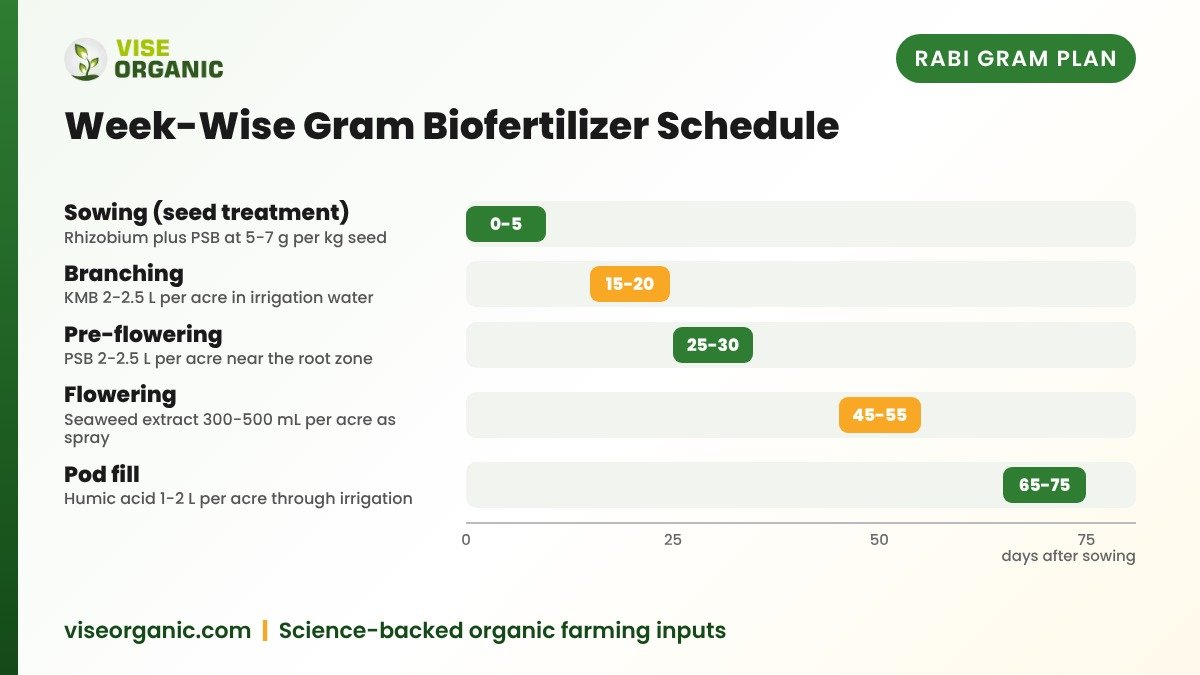
Read those numbers as published typical ranges, not a prescription. Your product label, your soil test and your local KVK extension officer decide the final rate, especially if your field already gets a heavy chemical programme.
The logic behind the timing is simple. Nodule formation starts within two to three weeks of germination, so rhizobium must be near the seed, not thrown on later. PSB works where roots are actively growing, so its soil dose goes in before flowering, when the plant's phosphorus demand climbs. KMB at 15-20 days supports the root system before the crop has to survive on stored moisture. Flowering and pod fill are the two stages where a dry, hot wind does the most damage, which is why seaweed and humate sit at those two points. If you want the wider timing logic across crops, this guide on When to apply biofertilizers for better crop results explains it.
Sandy and Calcareous Soil Adjustments
A sandy soil near Jaisalmer and a black cotton soil near Indore need different handling of the same cultures.
- Sandy soil. Add 1-2 tonnes of well-rotted farmyard manure or compost per acre before sowing, and put the soil doses into the irrigation water rather than broadcasting, since top-dressed powder dries out fast in loose sand.
- Calcareous soil (pH above 7.5). Raise confidence in PSB rather than in more DAP, and mix the culture with 200-250 kg of half-decomposed compost per acre so the cells are protected on the way in.
- Heavy or waterlogged soil. Keep the seed treatment light and rely on root-zone application, since waterlogging suppresses both nodulation and PSB activity.
- Reclaimed or low-organic-matter soil. Build carbon first with humate and compost, because every one of these microbes needs organic food to survive the winter.
Soil pH changes what these cultures can do at all. This practical walkthrough of Soil pH and biofertilizers shows how to read your own soil card before choosing rates. And if you have not tested in the last three years, do that before buying anything, as covered in Soil testing before biofertilizers.
Compost Enrichment and Soil Organic Carbon
A packet of culture applied to bare, tired soil mostly dies. The same packet mixed into compost that is already half-decomposed multiplies on the way in, and reaches the root zone with food attached. That is the cheapest upgrade available to a gram grower.
The method is straightforward. Take 1 tonne of well-rotted compost or FYM, wet it to a damp-but-crumbly state, mix in 5-10 litres of the same carrier cultures you would apply to the soil, cover with a sheet for 7-10 days in shade, and band it along the sowing line. Do not let the heap heat up above about 40 degrees Celsius or you will cook what you just paid for.
Why bother with carbon at all? Organic matter holds the moisture that keeps microbes alive between irrigations, feeds the microbial food web, and improves the soil structure that lets a gram taproot go deep. A rabi wheat field can be pushed with a similar compost and humate approach, as this plan for Soil organic carbon in rabi wheat explains, and the same logic carries to a legume rotation. Products like Eco Granule humic acid and seaweed powders such as Secure Power fit that carbon-and-root-support role.
Mixing Order and Tank Discipline
More culture is wasted in the spray tank than in the packet. A short list of habits protects the money.
- Check the label first. Confirm the crop, the stage and whether the product allows tank mixing before you open the drum.
- Use clean water. Fill with water that has stood free of chlorine or heavy bleaching, since treated municipal and chlorinated bore water harms live cells.
- Add in order. Water first, then the culture, then any permitted adjuvant such as Silk spreader sticker, never the reverse.
- Keep it cool. Spray before 10 am or after 4 pm, and never let the filled tank sit in the sun.
- Finish the day. Empty the tank into the field, rinse the boom, and do not leave culture standing overnight.
Irrigation water quality decides a lot of this. This field guide to Irrigation water quality and biofertilizers tells you what to test and what to change.
In gram, place the culture near the seed in shade and skip the sun; everything else is detail.
Safety and Label
Read the label on every pack before use: the crop, the dose, the batch date and the expiry are printed there, and an expired microbial product is close to worthless. Wear gloves and a mask while mixing powders and slurries, keep the mixing vessel away from drinking water and household utensils, and wash hands before eating or smoking. Store packs in a cool dark place between roughly 5 and 30 degrees Celsius, away from direct sun, pesticides and fuel. Never store microbial packs in the same compartment as chemical fungicides or bactericides. Keep all packs away from children and away from ponds, wells and canals.
For gram, do not expect a culture to replace a balanced fertiliser programme on a genuinely poor soil. It supplements phosphorus and potassium already present and adds nitrogen through nodules. If your soil test shows very low available phosphorus, you still need that phosphorus applied, with PSB making it work harder.
What to Check Before Buying in Bulk
Dealers and FPOs buying for a village or a cluster should verify five things before a single packet is paid for.
- Carrier and count. Ask for the carrier type (liquid or carrier-based) and the stated viable count per gram or per millilitre for that batch.
- Batch certificate. Every lot should come with a certificate naming the organism, the production date and the expiry, plus the registration details for the product.
- Packing condition. Foil pouches and drums must be sealed, undented and free of heat damage; swollen or leaking packs mean dead cells.
- Shelf life left. Do not accept stock with less than half its shelf life remaining, and check that the cold-chain history is honest.
- Storage at the dealer. Confirm the stock was kept in shade and out of heat, because a culture stored on a tin roof all summer is sold short of what the label claims.
Ask the supplier for a small trial lot for one or two fields before committing a whole cluster, and keep a treated strip as a comparison so you can judge the product on your own soil next spring.
Frequently Asked Questions
What is the rhizobium dose for gram seed treatment?
The common published range is 5-7 g of carrier-based rhizobium per kg of seed, so a 10 kg seed lot for one acre needs roughly 50-70 g. Treat in shade, dry in shade and sow the same day. Always confirm the rate on your product label.
Can I mix rhizobium and PSB on the same gram seed?
Yes, rhizobium and PSB are routinely applied together on legume seed and work at different places, one inside root nodules and the other in the soil around the roots. Do not add a chemical fungicide or bactericide to the same mix unless the label allows it.
When should KMB be applied in a rabi chana crop?
Most plans put KMB in the root zone at 15-20 days after sowing, during branching, at a typical 2-2.5 L per acre through irrigation water or as a soil application near the plant line. A late dose is of little use since the crop is closing its rows by then.
Is a seed treatment enough, or do I need soil application too?
Seed treatment gives the highest return per rupee, but a soil or fertigation dose later supports the population as the root system expands, especially in sandy or low-organic-matter soils where cells dry out. On a field with good compost history, seed treatment alone often does the job.
Will biofertilizers let me stop using DAP in gram?
Not on a soil that is genuinely low in available phosphorus. PSB helps free up phosphorus already locked in the soil, which can improve the return from what you apply, but the decision on basal fertiliser should follow your soil test and local extension advice.
How do I know the nodules are actually working?
Dig out a plant around 30-40 days after sowing with roots intact and look at the nodules near the upper roots. Working nodules are usually small and pink to reddish inside, while pale green or white nodules are fixing little. A local KVK or agronomist can confirm this in the field.
How long can treated gram seed be stored?
Sow it the same day you treat it. Microbial seed treatment is not a storage treatment, and viability drops quickly once the coating dries out, especially in warm dry air.
Conclusion
A gram crop feeds itself nitrogen if you place rhizobium on the seed in shade, and it finds its own phosphorus if PSB and KMB are in the root zone before flowering. Set the gram biofertilizer dose around those two facts, adjust for your soil texture and pH, and support the dry weeks with humate and seaweed rather than chasing the crop with more salts.
Start with a soil test, take the seed treatment seriously, and keep the rest of the doses on the calendar above. For rates on any of these cultures, browse Our products or Contact Vise Organic, and use Request a callback if you want crop advice for your own field.
Disclaimer: This article is general agronomic information. Results vary with soil, crop, weather and practices. Always read and follow the product label and consult a local agronomist for advice specific to your field.
Article Topics & Tags:
Vise Agronomy Team
The in-house agronomy and field research team at Vise Organic Biotechnology, publishing applied research on bio-fertilizer protocols, crop protection, and sustainable cultivation practices.