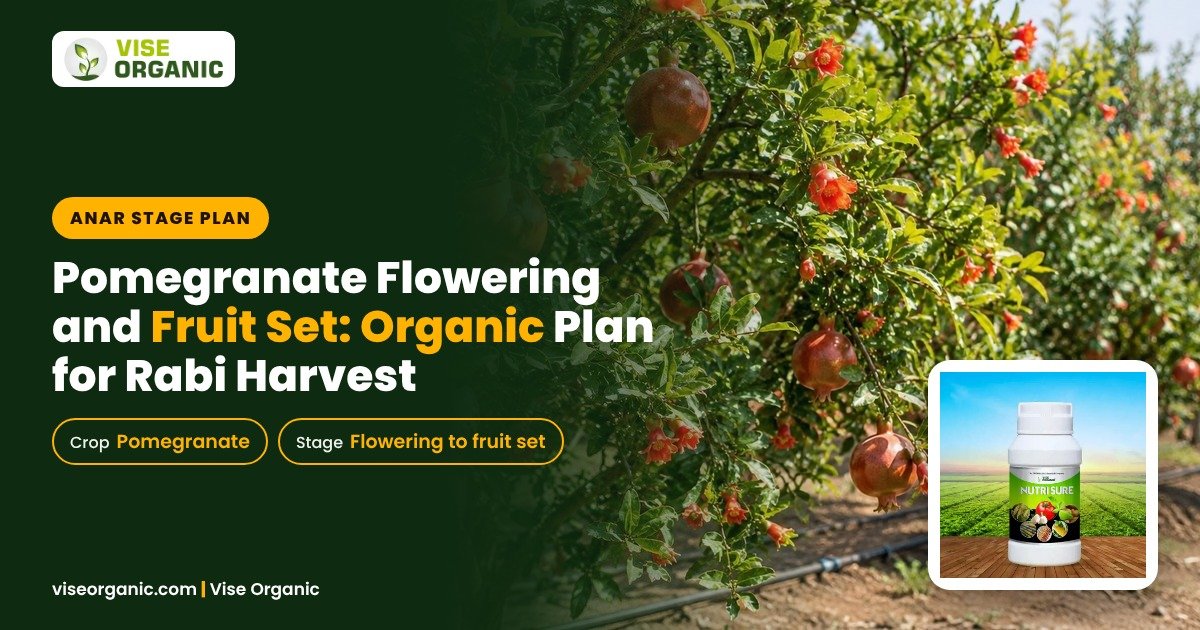
Your anar trees are full of orange bells, and ten days later half of them have dropped with the morning dew still on them. That is the usual sight in a Gujarat or Maharashtra pomegranate block in December, and it is the reason fruit set, not flower count, decides your income. Flowering and fruit set in pomegranate turns on nutrition, water steadiness and clean thrips management, and all three can be handled with an organic programme if you time it right.
This guide covers one specific window: the flowering to fruit set stage of rabi anar in Gujarat, Maharashtra and Rajasthan, from the first open bell to the stage when fruit is pea-sized. You get a stage-wise spray plan with typical label doses, the thrips checks that save the crop, the NPOP record work that keeps your fruit exportable, and a buying checklist if you are sourcing inputs as a dealer or FPO.
Why Pomegranate Drops So Many Flowers
Pomegranate is a hard crop to read. A single tree can carry thousands of bell-shaped bisexual flowers and a large number of smaller male (cup) flowers, and it is normal for the tree to shed most of the male flowers plus a big share of the fruit that has just set. In an untreated block you may see 60-80 percent of flowers and young fruit fall, and only a small number ripen.
Three things push that drop beyond the normal level. First, a flush of new growth at peak flowering pulls sugars away from the young ovary. Second, moisture swings, a dry week followed by a heavy irrigation, make the tree abort fruit to save water. Third, flower thrips feed inside the bell and scar the ovary, so the fruit sets crooked or falls within days. Nutrition alone will not settle a thrips problem, and sprays alone will not settle a water problem. Fix all three in the same window.
The Flowering to Fruit Set Calendar for Rabi Anar
In Saurashtra and Nashik, the rabi bahar usually opens from late November through December, with fruit set and pea-sized fruit through January and February, and harvest from late February into April. Zaid bahar comes later, in March-April, and needs the same plan shifted by about three months.
Say you grow three acres of gv-1 or gn-1 (ganesh) near Junagadh on drip. You open the season with the December round as bells appear, repeat at petal fall, then at pea-sized fruit, and finish with a pre-harvest round. Four rounds at a 12-15 day gap covers the whole window without crowding the tree.
Stage-Wise Organic Spray Plan
Every input below is used at the dose printed on the label; the figures given are common published ranges for these product types, and your block may need a small change. Do a bucket trial on ten trees before you fill the boom.
- Open the round at first bell. Spray a seaweed extract at 2-3 ml/litre with an amino acid at 1-1.5 g/litre, and add a spread adjuvant at 0.2-0.5 ml/litre so the solution runs into the bell rather than off the waxy leaf.
- Feed the root zone at bahar start. Apply 200-250 g/acre of a phosphate solubilizing bacteria (PSB) and 200-250 g/acre of a potash mobilizing organism through the drip or drench near the feeder roots, so phosphorus and potassium are moving when the tree needs them most.
- Repeat at 12-15 days with a humate plus seaweed. Run 250-500 ml/acre of a potassium humate through the drip and keep the seaweed spray at 2-3 ml/litre on the foliage to hold the young fruit.
- Scout for thrips before you spray anything else. Open ten bells across four corners of the block and count. At 3-5 thrips per bell, spray a botanical insecticide at 3-5 ml/litre with the adjuvant, and repeat once after 7 days if the count stays above 3.
- Carry the plan to pea-sized fruit. One more seaweed plus amino acid round at the same label rates holds the fruit through the cell-expansion phase.
- Log every round the same day. Note the product, batch number, dose, litres of water, weather and plot. Export buyers and NPOP inspectors ask for this register, not your memory.
Input Doses at a Glance
| Input | Typical dose per acre |
|---|---|
| Seaweed extract spray | 2-3 ml/litre |
| Amino acid spray | 1-1.5 g/litre |
| Potassium humate (drip) | 250-500 ml |
| PSB + potash mobilizer | 200-250 g each |
The seaweed spray is used as a foliar feed at 2-3 ml/litre of water on the leaf and fruit surface. Amino acid at 1-1.5 g/litre supports the growth spurt that comes with a new bahar. Potassium humate at 250-500 ml per acre goes through the drip to hold moisture in the root zone, and PSB with the potash mobilizing organism at 200-250 g each supports phosphorus and potassium supply all season. Our Seaweed extract and Amino acid pages carry the label details, and the Potassium humate page covers drip use.
Water, Canopy and the Fruit Set You Buy With a Saw
Most fruit set in pomegranate is bought with water and a pruning saw before it is bought with any bottle. Keep soil moisture even through flowering; short, frequent irrigation on the drip beats a heavy flooding that cracks the basin and shocks the tree. Hold back heavy nitrogen at peak flowering, since a leafy tree sets less fruit.
Open the centre of the tree. Remove water shoots, the low branches touching the soil, and the dense twig clusters inside the canopy so light and spray reach the inner bells. A shaded inner canopy breeds thrips and leaves the inside of the tree flowerless. Train to a single trunk with three to four primary branches, and keep one or two new shoots as next season's wood.
Thrips and Fruit Borer Without Residue Trouble
Thrips and fruit borer are the two pests that end an export lot. Scout weekly from first bell: open bells and count thrips, and look for the small pin-prick scars and silvering on the bell. Spray in the early morning when thrips are active inside the flowers, and point the boom at the bells, not just the leaves.
Use botanical and microbial options that suit a buyer's residue list, at the label dose, and rotate the actives across rounds rather than repeating one product. Take the Botanical insecticide and Botanical fungicide pages to your dealer and match them to what your buyer's residue list allows. Never mix a microbial product with a chemical fungicide or bactericide in the same tank unless the label clearly permits it. If your block is under certification, the permitted input list and the residue limits of the destination market decide what you may use, so check with your certifier before adding anything new.
NPOP Record Work for an Export Lot
If your anar is going to a market that screens residues, your paperwork is as important as your spray timing. NPOP certification of a farm or FPO is done by a certifier accredited by APEDA under the National Programme for Organic Production, and the rules of that programme, plus the importing country's limits, decide what is allowed on your certified land. The same field records feed both.
Keep four registers through the season: an input register with every product, batch number, dose, date and plot; an activity diary of irrigation, pruning, spraying and harvest by field; a harvest and lot traceability sheet linking each crate to a block and a harvest date; and a cleaning record for the packhouse and crates. Buy inputs against a bill that carries the batch number, store them in a shaded, ventilated store away from chemical packets, and never keep two similar cans half-used on the same shelf. Our Compliance page explains what we supply against this documentation. A clean block record also makes the annual inspection a 40-minute walk instead of a two-day scramble.
What to Check Before Buying in Bulk
Dealers and FPOs buying a season's input cover for 50 to 200 growers should verify five things before releasing an order. Ask for the CoA (certificate of analysis) of the specific batch you are receiving, not a generic one. Confirm the carrier and any inert content, since a wettable powder with the wrong carrier will clog a drip line.
- Batch certificate. Match the CoA batch number to the printed batch on every can in the lot before unloading.
- Shelf life. Check the manufacture and expiry dates and insist on at least eight to ten months of remaining life for microbial liquids.
- Packing integrity. Look for sealed caps, printed batch labels, and no swelling or leaking cans in a hot container.
- Storage at your godown. Keep the stock under shade below 35 degrees Celsius, off a concrete floor on pallets, away from direct sun and chemical pesticides.
- Label and registration. Read the crop, dose and compatibility statements on the label and confirm the registration matches the product being invoiced.
Order 30 to 45 days before bahar opens, since a microbial liquid that sits in a hot godown for two months loses its viability. Run a jar test with your tank water before a full drum, especially in hard-water belts of Saurashtra.
Safety and Label
Read the full label before the first round, including the crop, dose, pre-harvest interval and compatibility note. Wear gloves, a mask and full sleeves while mixing and spraying, and wash hands before eating or smoking. Never mix a microbial biofertilizer with a chemical fungicide or bactericide in the same tank unless the label allows it, and rinse the drum well after a chemical round before running a microbial dose through the same drip line. Store all cans away from children, food and any water body or well, and destroy empty cans rather than reusing them. Results vary with soil, crop, weather and the skill of your spray operator, so treat every number here as a starting point to check with your local KVK or agronomist.
Related reads: Zaid flowering fruit set chilli okra plan, Rabi wheat flowering grain fill organic plan, Mustard rabi biofertilizer plan
Frequently Asked Questions
When should I start sprays for pomegranate flowering and fruit set?
Start at first bell opening, usually late November to December for rabi bahar in Gujarat and Maharashtra, then repeat at petal fall, at pea-sized fruit and once more before harvest, with a 12-15 day gap.
How much flower drop in pomegranate is normal?
Pomegranate sheds most of its male flowers and a large share of newly set fruit on its own, so 60-80 percent fall can be normal. What you should worry about is a sudden spike after a moisture swing or a heavy thrips count.
Can I use biofertilizers and chemical sprays together in the same tank?
Not for microbial products. Do not mix a microbial biofertilizer with a chemical fungicide or bactericide unless the label clearly allows it. Space the rounds or run them through separate lines and rinse the drum in between.
How do I keep thrips below the damage level without residues?
Scout weekly by opening ten bells across the block. At 3-5 thrips per bell, spray a botanical insecticide at the label dose in early morning with a spread adjuvant, repeat once after 7 days if counts stay high, and rotate actives between rounds.
What records do I need for NPOP certification of a pomegranate block?
An input register with batch numbers and doses, a field activity diary, a harvest and lot traceability sheet, and a packhouse cleaning record. Buy inputs on bills that show the batch number and keep them for the annual inspection.
Is seaweed extract useful at flowering or only after fruit set?
It is used at both stages. At flowering it supports the pollination and set window; after set it supports cell expansion in the growing fruit. Follow the label dose on the pack rather than doubling it.
Should I prune anar before bahar?
Yes, light pruning before the bahar opens helps. Open the centre, remove water shoots and low branches, and let light into the inner canopy so sprays reach the bells and thrips have fewer shaded places to breed.
Conclusion
Pomegranate flowering and fruit set organic work comes down to four timed rounds, steady moisture, an open canopy and a thrips count you actually take. Start the seaweed and amino acid rounds at first bell, feed phosphorus and potassium through the root zone at bahar, keep the register clean for your certifier, and you will walk into harvest with a block you can sell into a demanding market. Browse the full range in Our shop and talk to our team about a season plan for your acreage, or Request a callback for crop-specific advice from an agronomist. For dealership or FPO bulk orders, Contact Vise Organic.
Disclaimer: This article is general agronomic information. Results vary with soil, crop, weather and practices. Always read and follow the product label and consult a local agronomist for advice specific to your field.
Article Topics & Tags:
Vise Agronomy Team
The in-house agronomy and field research team at Vise Organic Biotechnology, publishing applied research on bio-fertilizer protocols, crop protection, and sustainable cultivation practices.