A farmer near Bharatpur who sowed mustard in the first week of October often tells you the same thing in January: the field looks yellow at the edges, the plants stand short, and the potash that was paid for in October has not seemed to reach the crop. On many of those fields the soil is holding plenty of phosphorus and potassium, but the roots cannot reach it, and the organic carbon that used to feed the microbial work has run down.
That is where a planned rabi season input schedule earns its keep. This guide lays out one Mustard rabi biofertilizer plan for a 250-300 day mustard crop on typical Indo-Gangetic loams: what to put on the seed, what to feed to the soil at sowing, how to enrich farm compost before it goes into the field, and how to judge whether soil organic carbon is actually moving.
Why Mustard Runs Short Even on Fertilized Fields
Mustard takes a comparatively light dose of fertiliser per quintal of grain, yet it is unforgiving about phosphorus at the start and about potassium at the pod-filling stage. Phosphorus moves only a centimetre or two through soil, so a band placed at sowing is reached only by roots that grow into it. Potassium sits on clay exchange sites and is released slowly, and in the dry winter months, with little soil moisture and cool temperatures, that release slows further.
Microbial inputs work on exactly these two bottlenecks. Phosphate solubilizing bacteria (PSB) release phosphorus bound to calcium and iron in Indian soils, and potash mobilizing bacteria (KMB, often sold as a potash mobilizing microorganism) free potassium locked in illite and mica-type clays. Neither adds a new nutrient bag to your cost. They improve what your soil already holds, which is why they show up most clearly in fields that have been receiving the same DAP and MOP for years.
The Season Window: Sowing to First Flower
Rabi mustard in Rajasthan, Haryana, western UP, Madhya Pradesh and Punjab is sown between the last week of September and the second week of October, and flowers from late December to January. The microbial work has to be finished before flowering, because the root system and the branching pattern are set by 35-45 days after sowing.
Three dates matter. The first is the seed treatment day, one to two days before sowing, done in shade. The second is the sowing day itself, when any granular or broadcast input goes down and is covered. The third is the 20-30 days after sowing (DAS) irrigation, when a soil drench reaches an active root zone. Everything after that is canopy and nutrition support, not colonisation.
Seed Treatment: The Cheapest Place to Start
Seed treatment puts the organism where the root tip grows, in contact with the soil immediately around the seed. For mustard, a PSB carrier at 10-15 g per kg of seed, mixed with a sticker or 200 g of jaggery solution per kg of seed, is the common published practice. Do it in the shade, in a clean steel or plastic drum, and dry the seed in a thin layer on a gunny sheet under a shed for 30-60 minutes before sowing. Never treat seed in full sun, and never mix a microbial treatment with a chemical fungicide or bactericide in the same slurry unless the label clearly allows it.
Some mustard growers also ask about Rhizobium. Rhizobium works with legumes (the rhizobia that form nodules on lucerne, berseem, gram or lentil roots), not with mustard, which is a crucifer and forms no nodules. It belongs in this plan for the legume in your rotation, not for the mustard seed. Our Rhizobium liquid biofertilizer is meant for that companion or rotation crop.
Soil-Side Inputs at Sowing
Seed treatment touches only a few grams around each seed. The bulk of the root zone needs its own inoculation, and sowing time is the practical moment to do it. Two routes are used on rabi farms.
- Broadcast granular humate. Work Eco Green humic acid or a granule into the seedbed with the last harrow so it is mixed, not sitting on the surface, at the rate on the label.
- Furrow application. Run liquid PSB and KMB through the furrow of the seed-cum-fertiliser drill, or dilute and drench the furrow on a small plot, so the inoculant lands with the seed row.
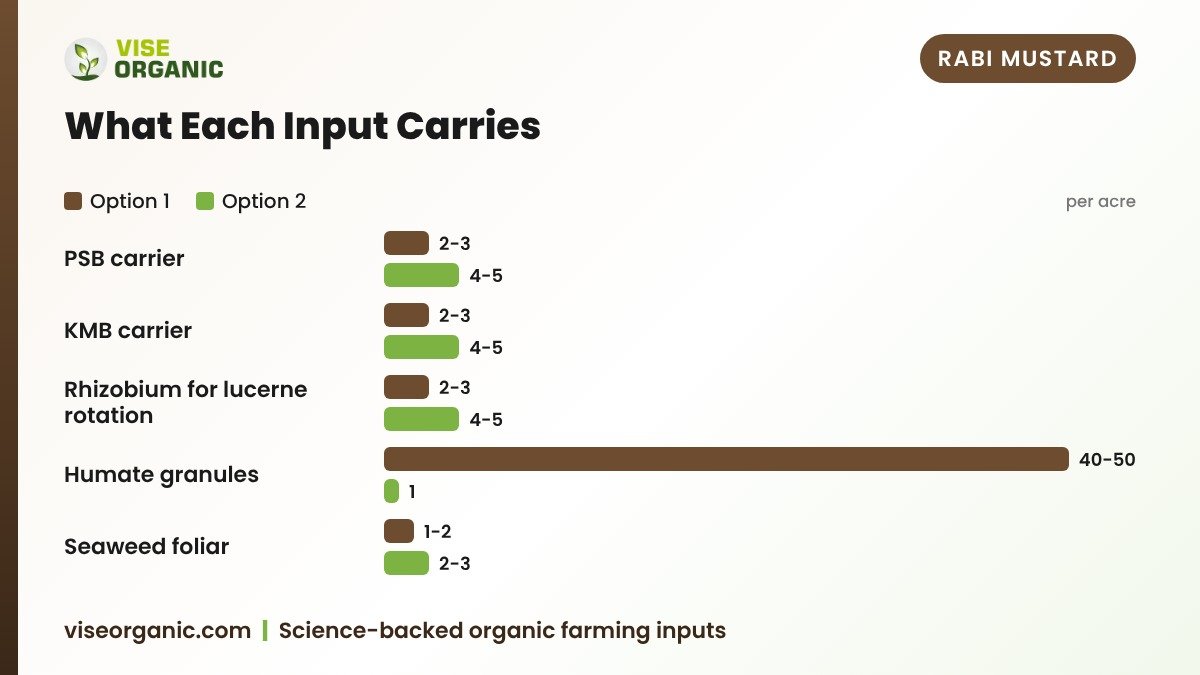
A typical field rate for a carrier-based PSB or KMB is 2-3 kg per acre, which covers 4-5 acres from a 10 kg pack. Liquid products are usually run at 1-2 litres per acre, again per label. If you are multiplying a carrier culture yourself, a PSB multiplier or KMB multiplier stretches the bulk, but only where you can keep the carrier moist and shaded; a dried-out carrier loses viable cells within days.
| Input | Typical Rate (per acre) | Method | Note |
|---|---|---|---|
| PSB carrier | 10-15 g per kg seed | Seed treatment | Dry in shade 30-60 min |
| PSB or KMB carrier | 2-3 | Furrow or drench | Covers 4-5 acres per 10 kg |
| Humate granule | 40-50 | Mixed in seedbed | Incorporate, do not leave on surface |
| Farmyard compost | 4000-5000 | Broadcasting before ploughing | Enriched, well-rotted only |
| Seaweed extract | 1-2 | Foliar at 25-30 DAS | With a spreader sticker |
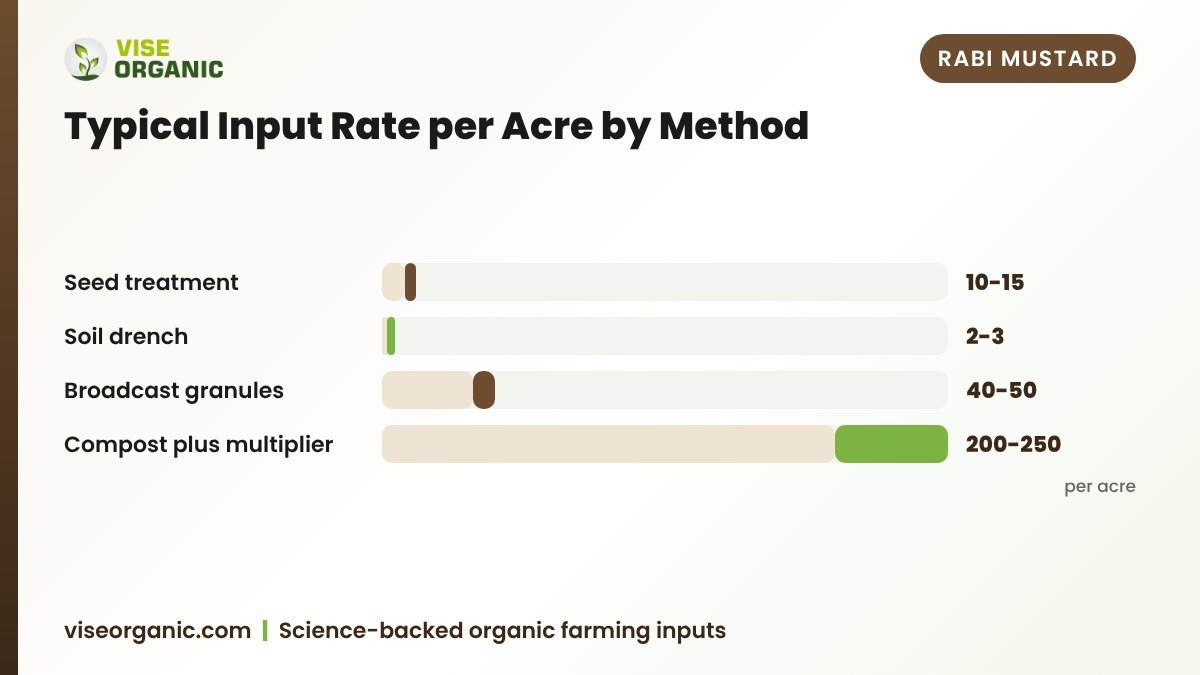
The numbers above are the same ones drawn in the chart below. Treat them as typical published ranges and confirm against the label of the pack you bought, since carrier strength and liquid counts differ between manufacturers.
The Field Schedule, Week by Week
What changes through the season is the place the input goes: seed, then seedbed, then root zone, then leaf.
| Stage | Days after sowing | What to do |
|---|---|---|
| Seed | 1-2 before sowing | Treat with PSB, dry in shade |
| Sowing | 0 | Humate into seedbed, PSB or KMB in furrow |
| Crown roots | 20-30 | Drench or irrigate in inoculant, first irrigation |
| Branching | 40-50 | Seaweed or amino acid foliar if leaves pall |
| Pre-flowering | 60-75 | Stop microbial drench, keep to label nutrition |
| Pod fill | 90-110 | Potassium support as per soil test, no drench |
Sown in the first week of October, a field reaches the 20-30 DAS drench window in the first half of November, when soil is still warm enough from the day for cells to multiply. Waiting until December puts the inoculant into cold, slow soil and the benefit drops sharply.
Enriching Compost Before It Goes In
Most mustard fields already get 4-5 tonnes of farmyard compost per acre. The gap is not quantity but quality: immature compost rots in the field and pulls nitrogen away from the seedling, and plain compost adds carbon with few solubilizing organisms.
Enrichment is a simple heap exercise. Spread the well-rotted compost on a shaded platform, sprinkle a jaggery-water suspension of PSB and KMB cultures over it while turning, keep the heap at 50-60 per cent moisture (it should hold together in a fist and crumble when pressed), cover with a gunny or polythene and let it sit 15-20 days before broadcasting. A 10 kg carrier culture is enough to enrich roughly 4-5 tonnes of compost, which is one acre's heap. Do not use fresh dung, raw urine or a heap that heats above 45 C, and never add a chemical fungicide to the heap.
One caution on the carbon question. Adding 4-5 tonnes of compost per acre every year builds organic matter slowly, and in most north Indian soils you will see a movement in measured organic carbon only after three to four seasons of consistent addition, not one. Judge it by a soil test from the same depth and same field corner each year, not by how dark the soil looks after a rain. For the deeper carbon and conditioning side of this, see our guide to Soil Carbone and soil conditioning.
Reading the Field: Signs the Plan Is Working
Give the plan 40-50 days before you judge it. Walk the field on a windless morning and compare against an untreated strip you deliberately left.
- Uniform colour. Leaves hold a steady dark green rather than pale edges at the row ends, which usually points to better phosphorus reach.
- Even stand. Seed treated with PSB tends to give a more uniform emergence because early root growth is faster and more even.
- Branch count. At 45-50 DAS, dig out two or three plants with soil intact and count branches and root length against the untreated strip.
- Flower timing. Flowering should arrive on the usual date for your variety, neither pushed early by stress nor badly delayed.
- Soil smell and crumb. After the first irrigation, healthy colonised soil crumbles and smells earthy rather than sour or flat.
If nothing differs from the untreated strip, the usual reasons are an old or heat-damaged pack, treatment done in sun, a fungicide in the same slurry, or a drench applied too late in a cold soil. Our checklist on How to evaluate biofertilizer performance walks through those one by one.
What to Check Before Buying in Bulk
Dealers and FPOs buying for a rabi drive should ask for paperwork before quantity.
- Content and count. Ask for the carrier or liquid count per gram or millilitre, and the organism named on the tag, not just "biofertilizer".
- Batch certificate. Every lot should carry a batch number, a manufacture date and a viable count certificate from the manufacturer's lab.
- Packing integrity. Carrier packs must be unbroken and free of damp patches; liquid drums must not be bulging, which signals contamination.
- Shelf life left. Buy carrier cultures with at least four to five months remaining and liquids with six months, so stock does not die in your godown.
- Storage at the point of sale. Packs must be kept off the floor, out of sun and below 35 C, never stacked against a west-facing wall.
Vise Organic makes microbial formulations in-house at Manjusar near Halol, Gujarat, including PSB, KMB, Rhizobium and Azotobacter products and multipliers, and the microbial formulations are DSIR-recognised. For a dealer or FPO order, write to sales at +91 84014 31440 or support@viseorganic.com.
Safety, Storage and Label
Read the label on every pack before opening it, and follow the crop, dose and mixing instructions printed there. Wear gloves and a mask while handling carrier powders and while treating seed, and wash hands before eating; do not prepare jaggery slurry in a vessel used for food. Keep microbial products away from children and away from wells, ponds and canals, and never rinse a spray tank into a water body. Store packs in a cool dark shed, away from sun, heat and chemicals, and separate them from fungicides and bactericides in the store room. Do not mix a microbial product with a chemical fungicide or bactericide in the same tank unless the label permits it. If your field is certified organic, check with your certifier against NPOP rules before adding any input; a product being microbial does not by itself mean it is approved for your certification. For how pH and lime status change microbial performance, our Soil pH and biofertilizer farmer guide explains the interaction, and the timing logic behind every rabi input is in When to apply biofertilizers for better crop results.
Frequently Asked Questions
Can I use Rhizobium on mustard seed?
No. Rhizobium forms nodules only on legume roots such as lucerne, berseem, gram or lentil. Mustard is a crucifer and does not nodulate, so use PSB on mustard seed and keep Rhizobium for the legume in your rotation.
What is the PSB dose per acre for rabi mustard?
A common published range is 10-15 g of carrier per kg of seed for treatment, or 2-3 kg of carrier per acre applied in the furrow or as a drench. Confirm the exact rate on your pack label, since carrier strength varies.
Can PSB and KMB be used together?
Yes, they are usually compatible because they work on different nutrients, phosphorus and potassium. Mix them only with water or jaggery solution, never with a chemical fungicide or bactericide unless the label allows it.
When should I stop applying microbial products in mustard?
Stop microbial drenches by 60-75 days after sowing, before flowering. Colonisation of the root zone is largely set by 35-45 days, so late drenches add cost with little effect.
Does compost raise soil organic carbon in one season?
Not measurably in most north Indian soils. Adding 4-5 tonnes of enriched, well-rotted compost per acre each season moves organic carbon slowly, usually visible in a repeat soil test after three to four seasons.
How do I enrich farmyard compost with biofertilizer cultures?
Spread well-rotted compost on a shaded platform, sprinkle a jaggery-water suspension of PSB and KMB over it while turning, hold moisture at 50-60 per cent, cover and rest 15-20 days before broadcasting. A 10 kg carrier culture treats roughly 4-5 tonnes.
How do I know the treatment worked?
Leave an untreated strip and compare at 40-50 days after sowing: colour, emergence uniformity, branch and root length on dug plants, and flowering date. If there is no difference, check pack age, storage temperature and whether a fungicide was in the same slurry.
Conclusion
A workable mustard rabi biofertilizer plan is short and dated: PSB on the seed one to two days before sowing, PSB or KMB in the furrow at sowing with humate mixed into the seedbed, a drench at the 20-30 DAS irrigation, enriched well-rotted compost before ploughing, and nothing microbial after the pre-flowering stage. Rhizobium belongs to the legume you rotate with, and any gain in soil organic carbon shows up across several seasons of consistent compost addition, judged by repeat soil tests. Results vary with soil, seedbed moisture, variety and how fresh the pack was, so keep an untreated strip each year as your own honest comparison.
Browse the Vise Organic shop for the microbial and humate range, and Contact Vise Organic or Request a callback for a district-specific rabi schedule or a dealer enquiry.
Disclaimer: This article is general agronomic information. Results vary with soil, crop, weather and practices. Always read and follow the product label and consult a local agronomist for advice specific to your field.
Article Topics & Tags:
Vise Agronomy Team
The in-house agronomy and field research team at Vise Organic Biotechnology, publishing applied research on bio-fertilizer protocols, crop protection, and sustainable cultivation practices.