Walk into a rabi mustard field in the first week of January and you will see the difference that decides your yield. Some fields carry a clean raceme with flowers opening in an even ring, while others show a pale tip, a few empty pods and flowers that opened for a day and dropped. Most of that difference comes from two nutrients that move badly inside the plant, boron and the pollination signal you support with 1-MCP. Getting the Mustard boron 1-MCP spray right is a mixing and timing job, not a guessing job.
This guide covers the one spray most farmers actually get in the flowering window, the correct order of putting things into the tank, the water pH and adjuvant that make boron work, and the records to keep if your mustard goes to an exporter or an NPOP certified block.
Why Flowering Is the Bottleneck in Mustard
Mustard takes up most of its boron during the rosette stage, before the stem stretches, and remobilises very little of it later. When the plant runs short at flowering, the pollen tube fails to grow, the ovule is not fertilised and the flower leaves an empty pod or no pod at all. You see it as a white or pale raceme tip, hollow stems (hollow stem disorder) and a field that looks good but threshes light.
Say you grow 3 acres of mustard near Bharatpur on flood irrigation, sowed in the second week of October. Your only realistic spray window falls between the last week of December and the first two weeks of January, before the plant is too tall to handle. One well-mixed tank that covers boron and pollination support does more for you than three poorly timed sprays.
The Spray Window by Stage
Mustard development is predictable enough to plan sprays by calendar days after sowing, adjusted for your variety and heat spells.
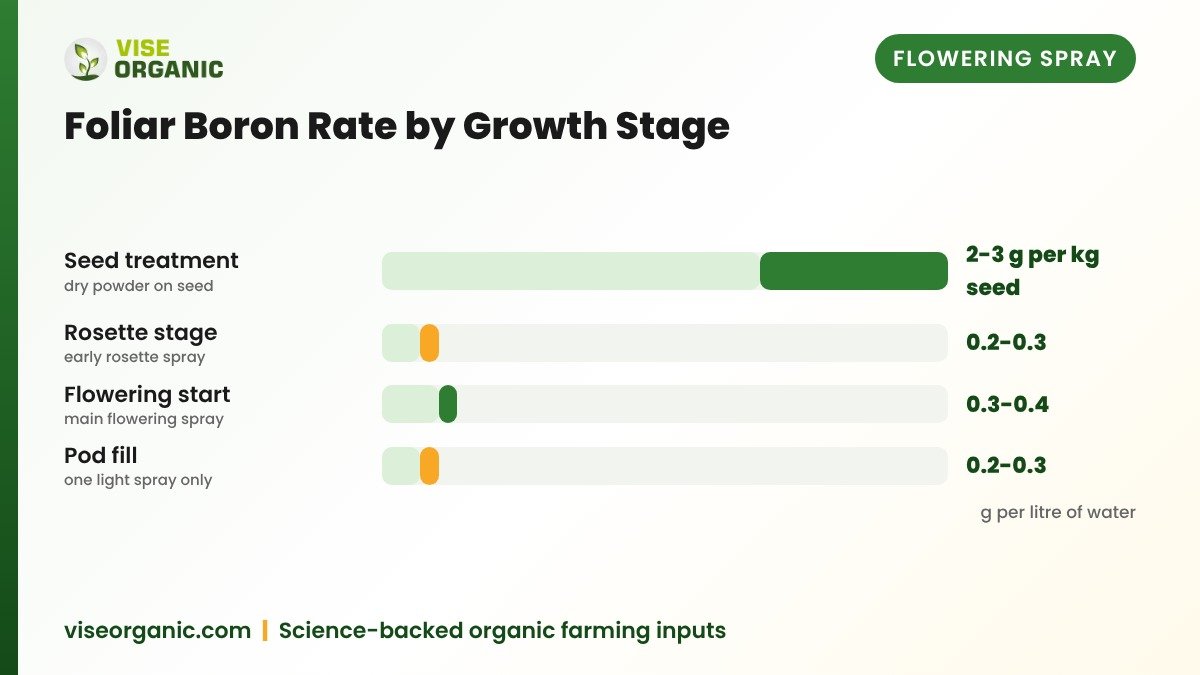
Spray at flowering start, roughly 35-55 days after sowing in the plains of Rajasthan, Madhya Pradesh, Haryana, Uttar Pradesh and Punjab. That single pass carries the boron dose of 0.3-0.4 g per litre and the 1-MCP dose on the label. Skip the peak bloom pass unless you can clearly see deficiency signs, because a crowded raceme with wet flowers gains little. At pod fill, 65-80 days after sowing, a light 0.2-0.3 g/L boron spray supports pod wall strength, and one pass is enough. For the full stage-wise plan, see our Flowering and pod fill spray schedule and the Rabi mustard care guide.
What Boron Does in the Tank and on the Flower
Boron is the nutrient that builds cell walls and lets the pollen tube grow. In mustard, a crop with a high boron demand, the response to a foliar spray is one of the more reliable ones you will see in rabi, provided the soil is actually short.
- Solubility. Use a fully soluble boron source such as borax (11-11.5% B) or solubor; undissolved granules in the tank block nozzles and waste the dose.
- Rate discipline. More boron burns leaf margins and can sterilise pollen. Stay at 0.3-0.4 g/L on the flowering spray.
- Timing beats rate. A correct dose at flowering start outperforms a double dose at pod fill.
- Soil first. If a soil test shows low boron, the basal or rosette application does the heavy lifting and the foliar spray only tops it up.
Dissolve the powder in a bucket of warm water first, stir till no grains remain, then pour into a half-filled tank. Check our Nutri Sure page for the special PGR range used in rabi flowering programs.
What 1-MCP Adds to the Spray
1-MCP (1-methylcyclopropene) blocks ethylene action in the plant tissue. Ethylene is the hormone that tells a flower or a young fruit to shed. In mustard, stress spikes of heat, a cold night, an aphid attack or a dry spell push ethylene up and the plant drops flowers and tiny pods it would otherwise hold.
Apply 1-MCP at the label dose on the flowering spray, one pass in the season. Two things decide whether it works:
- Active flowers. The compound acts on tissue that is metabolically active, so a spray on a crop still in rosette wastes the product.
- Coverage of the raceme. The flower and the young pod must be wetted. Fine droplets, 150-250 micron, with the boom low and slow beat a fast high-pressure pass.
1-MCP is a growth regulator, not a nutrient. It cannot fix a boron shortage, and it cannot fix a pollination problem caused by heat above 35°C during bloom. Pair it with boron, and keep the plant well watered for 4-5 days after the spray.
Tank Mix Order and Water Rules
Most tank mix failures in mustard sprays are mixing failures. Water quality in rabi in much of Rajasthan and Haryana is alkaline, pH 7.8-8.5, and alkaline water locks up boron and ruins the 1-MCP release.
- Clean the tank. Rinse out any previous chemical fungicide or bactericide residue; microbial products are killed by what is left behind.
- Correct the pH first. Bring water to pH 5.5-6.5 with a buffer before anything else goes in.
- Add dry in the right order. Wettable powder or granules, then water-dispersible granules, then suspension concentrates.
- Add the liquid formulation. 1-MCP or the PGR last among actives, with the tank agitating.
- Adjuvant at the end. A silicone or oil spreader at 0.25-0.5 ml/L, then top up to volume.
Never pour a dry powder straight into a full tank, and never add 1-MCP to a tank that still holds a strong alkaline chemical solution. If you also plan to use a botanical spray for aphids, keep it in a separate tank on a separate day; see our Neem oil spray timing for mustard aphids. Use Silk spread adjuvant or Plant Stick so the spray sticks to the waxy mustard leaf.
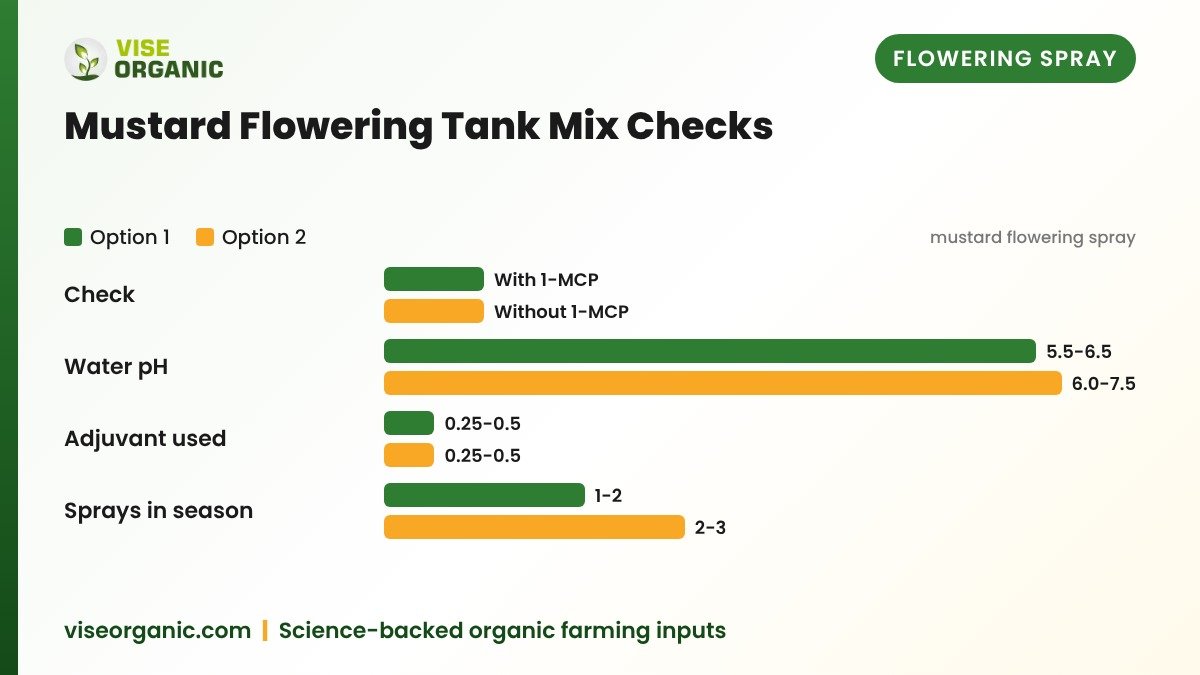
With 1-MCP in the tank, hold water pH at 5.5-6.5, use the adjuvant at 0.25-0.5 ml/L and expect 1-2 sprays across the season. Without it, ordinary water at pH 6.0-7.5 is tolerable for a plain boron spray and you may need 2-3 passes.
How to Mix and Spray, Step by Step
- Test the water. Dip a pH strip in a bucket drawn from the source you will spray. Above 7.5, buffer it before loading.
- Calculate the tank. A 15 litre knapsack covers about 0.25 acre with fine droplets. For 3 acres, plan 100-120 litres of water and multiply the g/L dose by total volume, not by tank count.
- Pre-dissolve the boron. Stir 4.5-6 g of soluble boron per 15 litre tank in a bucket of warm water until no grains are left.
- Half-fill and agitate. Load the tank half full, run the agitator, add pre-dissolved boron, then the 1-MCP at label dose.
- Adjuvant and top up. Add the spreader at 0.25-0.5 ml/L, fill to volume, and spray within 2-3 hours of mixing.
- Spray the raceme. Late afternoon, wind below 10 km/h, boom just above the canopy, one pass that wets the flowering tip without runoff.
Spray the flowering tip, not the leaves; mustard yields are made in the last 20 centimetres of the raceme.
For the pest side of the same window, follow the Mustard IPM spray calendar so your flowering spray does not collide with an aphid spray.
NPOP and Residue Notes for Export Blocks
If your mustard goes through an exporter or sits in an NPOP certified block, the input list is decided by your certifier and the NPOP standard, not by what is available at the shop. 1-MCP is a synthetic post-harvest and plant growth regulator technology and is generally not part of an input list for certified organic production. Keep it out of certified acres and discuss any doubt with your inspector before the spray day.
- Log every input. Product name, batch number, dose, acre, date and water pH go in the field register on the spray day.
- Keep the bills. Purchase invoices for each input, matched to the field register.
- Reserve one tank. Certified blocks use their own cleaned sprayer, never the tank that carried chemical fungicides.
- Follow the harvest interval. Observe the pre-harvest interval on every label and write it in the register.
- Map the block. Field boundaries, buffer zones and the source of irrigation water are part of the inspection file.
Our NPOP input checklist for FPO export crops and NPOP certification export crop records cover the paperwork in detail, and the Residue-free grape export plan shows how a full residue management season is documented.
Safety and Label
Read the full label of both products before mixing, including the re-entry interval. Wear gloves, a mask and full sleeves; wash hands before eating or smoking. Do not spray near a pond, canal or well, and never wash the tank into a water body. Store 1-MCP in a cool dry place away from children and sunlight, and keep it sealed until use, since the active releases on opening. Do not tank-mix a microbial biofertilizer with chemical fungicides or bactericides unless the label clearly allows it. If your water source or soil test is unusual, ask your local KVK or an agronomist before changing doses.
Frequently Asked Questions
When should I spray boron on mustard?
The main pass goes on at flowering start, roughly 35-55 days after sowing in North Indian plains. A light 0.2-0.3 g/L spray at rosette, 25-35 days, helps where a soil test shows low boron, and one light pass at pod fill supports pod wall strength.
Can I mix boron and 1-MCP in the same tank?
Yes, in a clean tank with the water buffered to pH 5.5-6.5. Add the pre-dissolved boron first with the agitator running, then 1-MCP at label dose, then the adjuvant, then top up with water. Do not add either to a tank holding alkaline chemical residue.
What is the right boron dose for mustard spray?
Typical published foliar rates are 0.3-0.4 g per litre at flowering with a fully soluble source such as borax or solubor, and 2-3 g per kg for seed treatment. Treat these as typical ranges and follow the product label for your specific formulation.
How much water should I use per acre for the flowering spray?
Plan 100-120 litres of water per acre with fine droplets and a low boom so the raceme is wetted. Calculate the dose in grams per litre and multiply by the total volume, not by the number of tanks.
Does 1-MCP increase mustard yield?
1-MCP reduces ethylene-driven flower and young pod drop during stress such as heat, cold nights or aphid attack. It is not a yield product by itself and cannot correct a boron shortage or pollination failure from extreme heat. Actual response depends on soil, variety, weather and crop nutrition.
Is 1-MCP allowed in NPOP certified organic mustard?
1-MCP is a synthetic plant growth regulator technology and is generally not on the input list for certified organic production. Your certifier and the current NPOP standard decide what is allowed, so confirm in writing with your inspector before using anything on certified acres.
My mustard field shows white raceme tips and hollow stems. What is wrong?
Those are classic boron deficiency signs, often made worse by dry soil at rosette or heavy lime. Spray boron at 0.3-0.4 g/L at once, keep the crop watered, and plan a soil test plus a basal or rosette boron application for next season.
Conclusion
The flowering spray is the highest-value pass in a rabi mustard crop. Fix the water pH, keep boron at 0.3-0.4 g/L at 35-55 days after sowing, add 1-MCP at label dose once, and mix in the right order, and a Mustard boron 1-MCP spray does exactly what it should. Results still depend on your soil, variety, heat during bloom and how well the crop is watered, so judge your own field, not your neighbour's.
Talk to our agronomy team about the flowering program for your acreage or your FPO block, and browse Our products for the adjuvants and PGR range used in rabi. For crop-specific advice, dealership or bulk orders, Contact Vise Organic or Request a callback.
Disclaimer: This article is general agronomic information. Results vary with soil, crop, weather and practices. Always read and follow the product label and consult a local agronomist for advice specific to your field.
Article Topics & Tags:
Vise Agronomy Team
The in-house agronomy and field research team at Vise Organic Biotechnology, publishing applied research on bio-fertilizer protocols, crop protection, and sustainable cultivation practices.