You walk the trellis at seven in the morning and the first split fruit is already on the ground, a neat round hole in it with frass around the edge. That hole is not a borer and it is not a disease. It is bitter gourd fruit fly, and by the time you see the hole the damage was done eight to ten days earlier, when the female laid her eggs inside a young fruit. Bitter gourd fruit fly IPM works because you act before the hole, on the flower, on the trap and on the field edges, and only then with a botanical spray.
This guide covers the whole sequence for karela in zaid and early kharif: how to tell the male and female flower apart, what to count each morning, the sanitation habits that cut the next generation, and where neem and botanical sprays and microbial biopesticides fit in the calendar.
Why Flower Work Comes Before Any Spray
Fruit fly females are attracted to the flower, not the fruit. They sit on an open flower or a fruit two to four days old, and the sting mark they leave is what later turns into that hole. Nothing you spray on a big green fruit reaches a fly that is feeding on a flower in the shade of the canopy, which is why a spray-only programme keeps failing in bitter gourd.
Flower work means scouting the flowers themselves, removing what is already stung, and keeping the trellis open enough that a spray actually lands where the flies sit. The rest of this article hangs on that one idea.
Reading the Damage Before You Pick a Product
Before choosing a spray, confirm what you are dealing with. The signs look similar to other fruit feeders and getting this wrong wastes two spray cycles.
- Clean round exit hole. A single neat hole on one fruit with moist sawdust-like frass at the rim, usually on a fruit 6-10 cm long, points to fruit fly larvae feeding inside.
- Yellowing and collapse from the tip. A fruit that softens and turns yellow from the stylar end while still small is usually a stung fruit that was punctured a few days back.
- Scarred, corky patches. Rough corky scars spread over the fruit surface with no hole come from poor pollination or thrips rubbing, not from fruit fly.
- Chewed margins with frass on the soil. Torn leaf edges and wet droppings under the vine indicate caterpillars like semilooper, a different problem with a different timing.
If two or three fruits in ten show a hole or a soft patch, you are past the scouting stage and into a spray-plus-sanitation week.
The Male Female Flower Ratio That Decides Your Week
Bitter gourd opens male flowers first and female flowers later, and the ratio shifts through the crop. Counting is the cheapest tool you have, because a crop carrying many more male than female flowers is not yet at risk, while a crop with a heavy flush of female flowers at the same time is exactly when flies concentrate.
Say you grow two acres of karela near Bharatpur on flood irrigation in the second half of April. Your first week of flowering is almost all male flowers, and you will spend that week on traps and sanitation rather than on the sprayer. When the female flowers arrive in a flush ten to twelve days later, that is the week you spray and you spray the flowers, not the fruit.
For a practical read, walk a fixed line of ten plants and count 20 open female flowers across them.
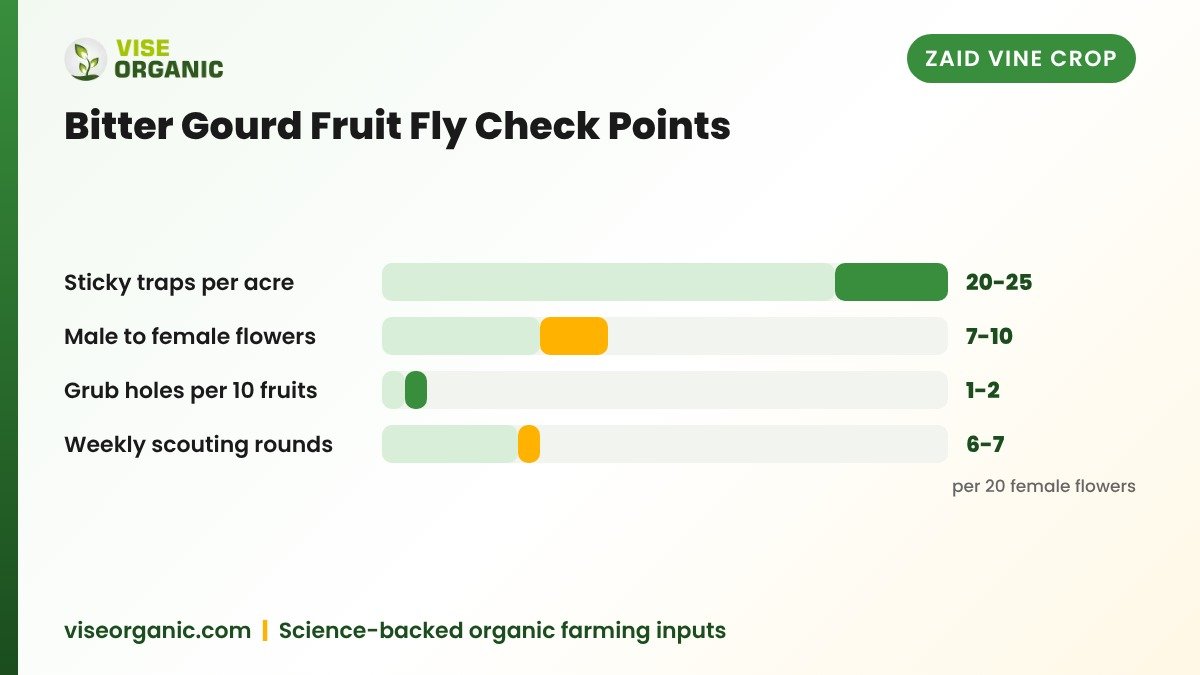
Read the numbers as a set, not one at a time. Traps catching more flies than the previous week, together with one or two stung flowers in twenty, is the signal to spray that evening. For a fuller calendar view of the same crop, the Mustard IPM spray calendar follows the same logic of scouting first and spraying on a trigger, and Chilli thrips IPM with botanical spray timing shows how a flower-feeding pest is handled on another vegetable.
Field Sanitation, the Step Most Growers Skip
Flies develop inside fallen and stung fruits. One ignored fruit on the soil can produce a new batch of adults, so sanitation lowers the pressure your sprays have to work against.
- Collect every fallen fruit. Walk the rows with a bucket each morning and pick up dropped and stung fruits, including those caught in the vine.
- Deep bury, never compost. Bury collected fruit in a pit at least 45 cm deep and cover with soil, so pupae cannot emerge; a heap at the field edge becomes a breeding bench.
- Open the canopy. Tie the main vines up and remove old yellowed leaves at the base so sprays reach the flowering zone and flies have no shaded resting spot.
- Keep the edges clean. Clear weeds and crop residue for one metre inside the boundary, where adult flies rest through the hot afternoon.
- Harvest on size, not on colour. Pick at the tender stage every two to three days; fruit left to ripen on the vine becomes a fly nursery and also slows the next female flush.
Pick the stung fruit before you mix the tank, and half your next spray becomes unnecessary.
Trap Design and Where to Hang Them
Yellow sticky traps do two jobs: they tell you when flies arrived and they pull out some males. Hang them at the top of the trellis or just above the canopy, since fruit flies fly slowly along the top of the foliage rather than near the ground.
- Install before flowering. Put traps out at 20-25 per acre when the first male flowers open, not after you find damage.
- Place on the windward edge. Flies arrive with the wind, so the first traps go on the side the afternoon wind comes from, with the rest spread across the block.
- Add a male attractor. A methyl eugenol or cue-lure pot on one trap per 400-500 sq m draws males and gives a much clearer arrival date than sticky boards alone.
- Replace when dirty. A board covered in dust or leaf litter stops catching; change or re-glue every 10-15 days in summer heat.
Do not use traps as your only control. They are a monitoring tool first, and a block with traps but no sanitation will still show holes in the fruit.
Spraying Botanicals on the Flower, Not the Fruit
This is where bitter gourd fruit fly IPM is won or lost in the spray tank. Adults mate and feed in the morning on flowers, so a contact botanical applied in the evening protects the flower surface that the flies will walk on the next morning.
- Time to the leaf-dry window. Spray between 3 and 6 pm when leaves are dry but the sun is low; morning spraying washes off with dew and midday spraying evaporates.
- Aim at the flowering zone. Direct the lance at the underside and inside of the canopy where open flowers sit, using a fan or hollow-cone nozzle at low pressure rather than a hard jet.
- Cover the whole block. Flies move in from the edges, so patch spraying only the damaged rows leaves the next generation intact.
- Use a spreader on waxy leaves. Bitter gourd leaves are hairy and rough, so a spreader sticker like Silk or a Plant Stick improves coverage on both leaf and petal.
- Rotate modes, not brands. Alternate a neem-based contact product such as Eco Cover with a botanical spray on the label's dose, so one mode of action is not used in back-to-back sprays.
Spray intervals depend on weather more than on the calendar.
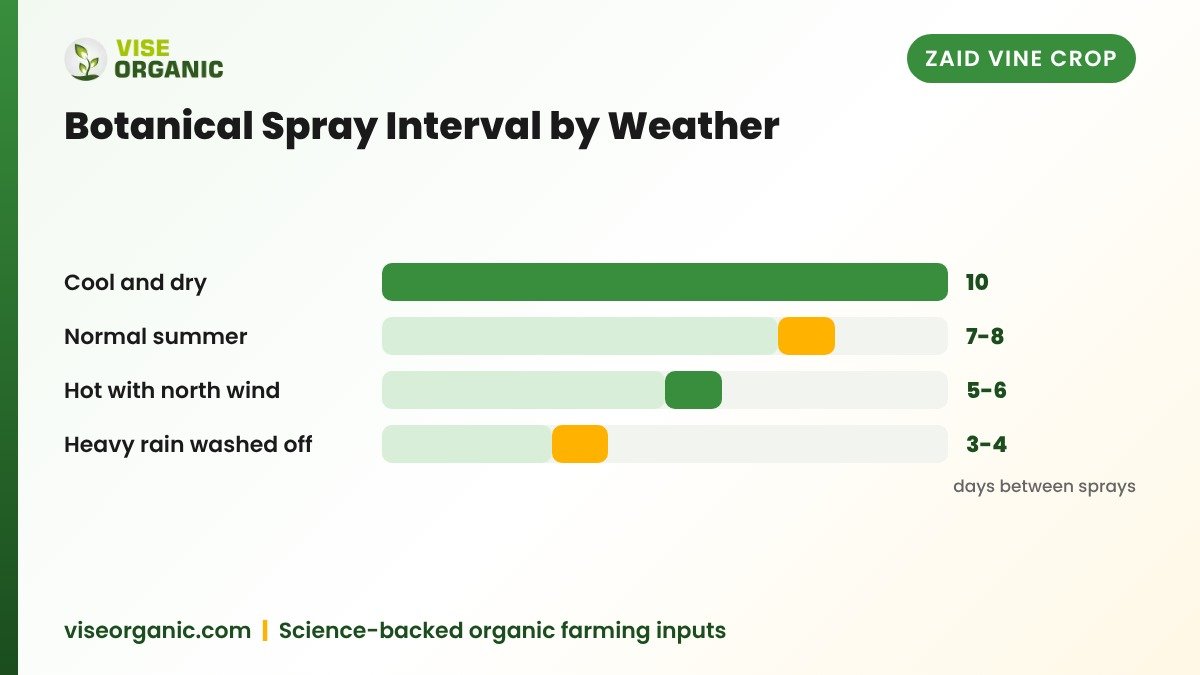
Follow the label dose of the product you hold and ask your local KVK or a Vise Organic agronomist for the rate suited to your plant size and volume of water. For a disease-side companion on the same vine, Bacterial pathogen disease spray timing on tomato covers the same principle of a fixed interval tied to weather and stage.
Mixing Rules in the Tank
Fill the tank half with water, add the product measured in a separate mug, then make up the volume and keep the agitator running. Do not tank-mix a microbial or botanical spray with a chemical fungicide or bactericide unless the label specifically allows it, and never keep a mixed tank overnight; mix only what the block needs.
A Week-by-Week Plan From Trellis to Harvest
The plan below assumes a zaid planting with trellis, flowering from about day 35 and first harvest from day 50-55.
| Stage | Days After Sowing | Action |
|---|---|---|
| Trellis on | 25-30 | Canopy tied open, traps ordered |
| Male flower flush | 35-40 | Traps at 20-25 per acre, start daily rounds |
| Female flush begins | 45-50 | First botanical spray, evening, on flowers |
| Peak flowering and set | 50-75 | Spray at 7-8 day interval, sanitation daily |
| Main harvest | 55-90 | Harvest every 2-3 days, rotate spray modes |
Two weeks into harvest, watch the trap counts as much as the fruit. A sudden rise in trap catch after a dry hot spell usually means a neighbouring field has been harvested and the flies have moved to yours. For the degree-day version of that thinking, Onion thrips spray timing using degree days explains how heat drives spray gaps in another summer vegetable.
Safety and Label
Read the full label before mixing, including the waiting period before harvest, which matters most in a crop you pick every two days. Wear gloves, a mask and full sleeves, and wash after mixing. Do not spray near a pond, well or canal bank, and never wash the tank in a water source. Store packs in a cool dry shed away from sunlight, feed and children. Botanical and microbial products are not harmless: they burn eyes and skin the way any pesticide does, and they harm bees on contact, so keep off flowering bee-attracting weeds while spraying.
What to Check Before Buying in Bulk
Dealers and FPOs buying botanical sprays for a karela belt should verify the pack before it reaches farmers.
- Registered content. Ask for the content stated on the label and match it to the CIB&RC registration number printed on the pack.
- Batch certificate. Get the batch number, manufacturing date and a certificate of analysis for that batch, with microbial count or active content stated.
- Packing integrity. Look for sealed, light-resistant containers with no swelling or leakage; swollen bottles mean heat damage in transit.
- Shelf life left. Confirm at least 8-10 months of shelf life at the time of delivery, and check the storage advice for temperature limits.
- Storage at your godown. Keep stock off the floor, out of sun, below hot storage conditions, and issue stock batch-wise so nothing sits past its date.
Buyers can review the range at Our products and ask for batch documents from the company directly.
Frequently Asked Questions
How do I tell a male from a female bitter gourd flower?
A female flower carries a tiny spiny fruit at the base of the petal, the size of a grain of rice or smaller. A male flower sits on a plain thin stalk with no fruit beneath it. That small fruit at the base is where the fly stings, so female flowers are your scouting target.
When should I hang yellow sticky traps in bitter gourd?
Hang 20-25 traps per acre at the top of the trellis when the first male flowers open, roughly 35-40 days after sowing. Waiting until you see holes in fruit means the traps arrive two weeks too late to guide your first spray.
What is the action threshold for fruit fly in bitter gourd?
Count 20 open female flowers across a fixed line of ten plants. One or two stung flowers in that twenty, or a trap catch higher than the previous week, is the trigger for a botanical spray that evening plus daily fruit collection.
Should I spray bitter gourd in the morning or evening?
Late afternoon, between 3 and 6 pm, when the leaf surface is dry and the sun is low. Adults mate and feed on flowers in the following morning, so an evening spray is positioned on the flower exactly when the flies walk on it.
Can I spray a botanical product every three days to be safe?
Repeated short-interval spraying of the same product selects for resistant flies and burns money. Rotate between different modes of action, keep to the label dose, and let sanitation and traps carry the load so the spray interval can stay at 7-8 days in normal weather.
Are microbial biopesticides useful against bitter gourd fruit fly?
Microbial products work on caterpillars and some other pests, not on sucking or stinging adult fruit flies, so use them for a chewer problem if one appears. For fruit fly, the useful inputs are sanitation, traps, neem and botanical contact sprays on the flowers, and a spreader for the hairy leaves.
What do I do with stung fruit already on the vine?
Pluck it and bury it in a pit at least 45 cm deep with soil on top. Do not throw it in a canal, a field ditch or a compost heap at the field edge, since the pupae inside will emerge as the next batch of adults.
Conclusion
Bitter gourd fruit fly IPM is a morning habit, not a spray: count the flowers, trap before flowering, bury every stung fruit, and put the botanical on the flowering zone in the evening at a weather-adjusted interval. Do those four things together and the holes in the basket drop week by week; skip sanitation and no tank mix will hold the damage back.
For a spray plan matched to your variety, block size and local fly pressure, talk to our team at Contact Vise Organic or Request a callback for crop advice, and browse Our products for botanical and spreader options.
Disclaimer: This article is general agronomic information. Results vary with soil, crop, weather and practices. Always read and follow the product label and consult a local agronomist for advice specific to your field.
Article Topics & Tags:
Vise Agronomy Team
The in-house agronomy and field research team at Vise Organic Biotechnology, publishing applied research on bio-fertilizer protocols, crop protection, and sustainable cultivation practices.