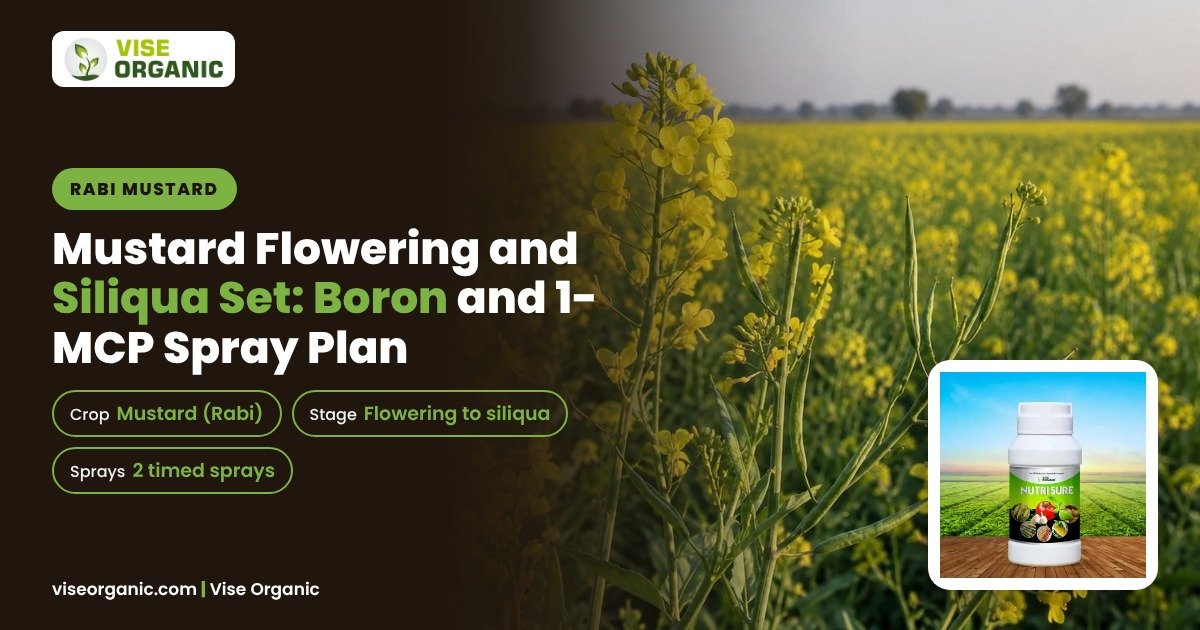
You walk the field in late December and the mustard looks perfect. Yellow flowers everywhere, bees working the rows, and you start counting siliquae in your head. Then you open five or six flowers and find two thin siliquae instead of four, and some flowers have dropped with a shrivelled ovary inside. That gap between flowering and siliqua set is where a rabi mustard crop is really won or lost.
This guide is a mustard flowering spray plan built around two inputs that do most of the work at that stage: boron and 1-MCP. You get the exact stages to spray, the water volume per acre, tank mix rules, and what to change if your block is inside an NPOP certified group. It also covers the field signs that tell you which of the two your crop is short of.
Why Flowers Fall Off After Flowering
Mustard does not set every flower it opens. A plant typically sets a little over half of them, and the rest abort. What you are managing is that abort rate, and it climbs when three things go wrong at once.
Pollen needs boron to germinate on the stigma and grow a pollen tube. Boron is also phloem-mobile in only a limited way, so it does not move well from old leaves into new flowers. A plant that got a weak basal dose early cannot shift more boron into the flowers later. Cold nights below 8-10°C slow pollen tube growth for a few days, and those flowers usually abort.
The second mechanism is hormonal. After pollination, the flower starts producing ethylene, and ethylene is the ripening and ageing signal. Too much of it and the plant sheds the flower or a young siliqua instead of filling it. Heat, water stress, physical damage and heavy thrips feeding all push ethylene up. That is the problem 1-MCP is meant to interrupt.
Boron at the Right Stage
Boron in mustard is usually supplied as borax or Solubor. Typical published use is 20-40 g per 10 litres of water, which works out to roughly 60-120 g per acre depending on how much water you run. Check the label on the pack you bought and confirm the rate with your local KVK, because soil test boron changes what your field actually needs.
Split it. Half goes into the first spray at primary branching, around 30-40 days after sowing, and half at early flowering around 50-55 days. A single heavy dose at flowering wastes part of it, and a full basal dose in the soil can run past safe limits in sandy soils.
Watch for the empty-flower sign. Hollow flowers with no green ovary behind them, or siliquae that are short and contain no seed, point to boron. Brown or black patches inside the stem and a hollow pith point to sulphur or a disorder called hollow stem, which is a different problem and needs a soil test.
What 1-MCP Does for Fruit Set
1-MCP is a volatile molecule that occupies the ethylene receptor in plant tissue. Once the receptor is blocked, the ethylene signal cannot get through, so the abscission zone at the base of the flower does not get the drop order. It is used as a wettable powder at very low rates.
Typical label use for field crops runs 5-10 g per 10 litres of water, which is 30-60 g per acre. That is a small quantity, so weigh it on a proper scale rather than guessing with a spoon. Dissolve the powder in a bucket of clean water first, then pour it into a half-filled tank and make up the volume.
Two things matter more than the dose. First, timing: it must reach flowers that are open or about to open, not old flowers already yellowing at the edges. Second, coverage: the solution has to land on the flower. A coarse jet that runs down the stem and misses the cluster does very little.
The Spray Calendar
Say you grow 4 acres of mustard near Bharatpur on flood irrigation, sown on 15 October. Your flowering window falls in the first three weeks of January, and that is where your two sprays go. If a cold spell hits around 55 DAS, hold the flowering spray by 4-5 days so it lands on fresh flowers rather than on stalled ones.
The plan below is a typical schedule for normal rabi weather. Adjust by 5-7 days either way for your own sowing date and temperature.
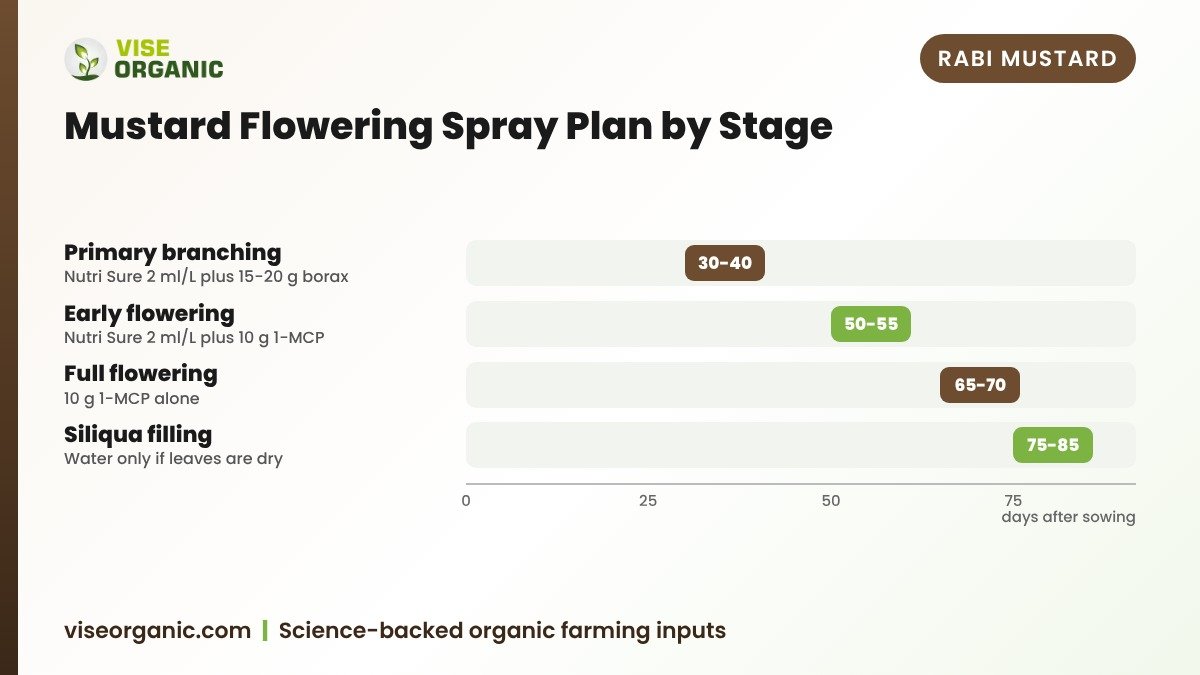
Read the label of every product you mix and keep the weakest rate that the label allows. In the chart above, the boron splits at 30-40 and 50-55 days, the 1-MCP goes at 50-55 and 65-70 days, and nothing is sprayed once siliquae start filling.
Water Volume and Nozzle Setup
Spraying 1-MCP and boron over a canopy of flowers is a coverage job, and coverage is decided by water volume, not by chemical rate. Most fields need the volumes below.
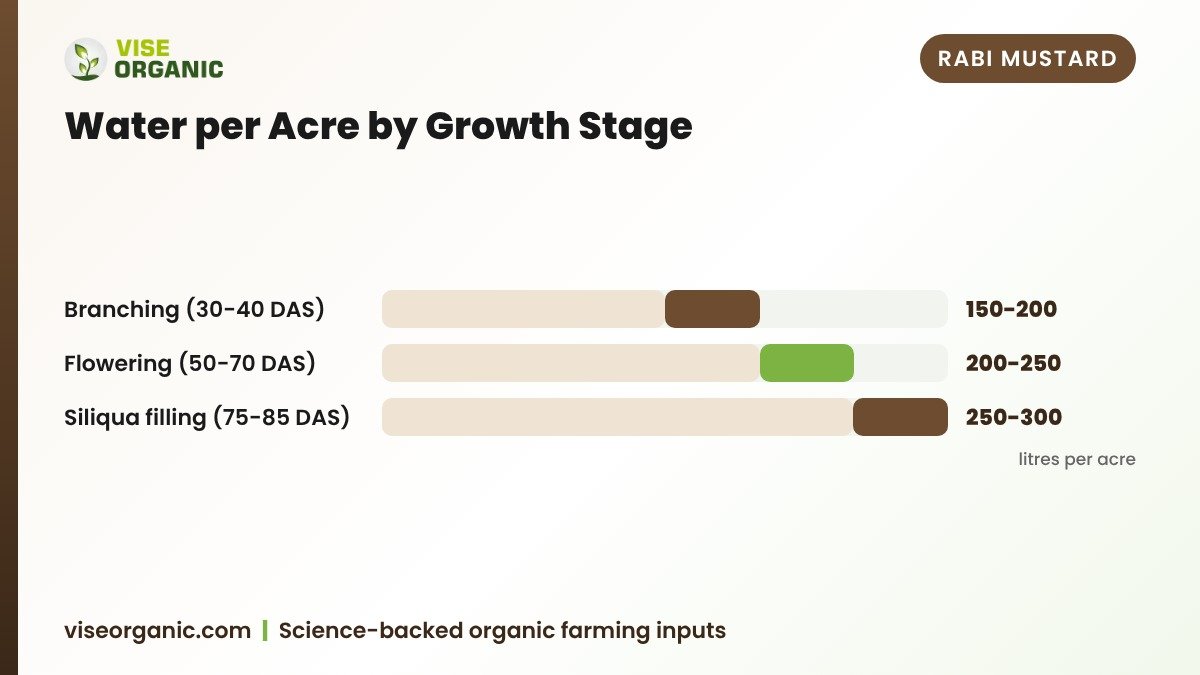
Those are litres per acre. A knapsack holds about 15 litres, so the flowering spray means 13-17 tankfuls per acre; if you are finishing an acre in 6 tanks, your droplets are too coarse and too fast.
Spray in the morning between 9 and 11 after the dew has dried, or in the late afternoon. Avoid the middle of the day when the temperature crosses 32°C, because droplets dry before the flower can take them in. Use a flat-fan or hollow-cone nozzle at 2-3 bar with a coarse to medium droplet. Low pressure and a slow walking pace beat high pressure every time.
Tank Mix and Order
A clean tank mix protects both the flowers and your certification records. Work through it in this order.
- Fill the tank half. Start with clean water at about half the volume, since additives go into water, not into an empty tank.
- Pre-dissolve the powders. Slake borax or Solubor in warm water in a bucket, and dissolve the 1-MCP powder separately, then add both.
- Add the liquid product next. Pour Nutri Sure or Nutri Wheat through the strainer, then any adjuvant such as Silk or Plant Stick.
- Make up the volume and mix. Top up to the full volume, agitate for a minute and spray the same day; do not leave the tank standing overnight.
Do not tank mix 1-MCP with strongly alkaline products, copper or bactericides, since high pH breaks the molecule down fast. If your block also needs a microbial spray, keep it a separate pass a week apart; for the bio input side of the same crop, see the Mustard rabi biofertilizer plan.
If Your Block Is Under NPOP
NPOP and NOP rules are decided by your certifier and the input list of your certification body, not by a blog. What a flowering spray plan changes in a certified block is documentation and a little product selection.
- Check the input list first. Before the season, get written approval for every product you plan to spray, including any PGR, from your certification body.
- Keep a spray register. Record date, crop stage, product, batch number, rate, water volume and operator for every pass, since auditors read it line by line.
- Do not mix in old cans. Rinse any knapsack that carried a synthetic growth regulator or hormone before it enters a certified block.
- Follow the pre-harvest interval on the label. For residue-free export lots, keep your own records of the last spray date against the harvest date.
- Segregate the lot. Harvest, bag and store certified produce separately from your conventional plot so the traceability chain stays clean.
The NPOP input checklist for FPO export crops covers the paperwork in more detail, and the NPOP certification and export records guide explains the record format an auditor expects.
Other Things That Set Flowers
Two field operations affect siliqua set as much as any spray. The first is irrigation. Mustard needs critical moisture at branching, flowering and siliqua development. A dry spell at flowering raises flower drop fast, and a heavy irrigation just before flowering can push fresh growth at the cost of buds. Keep soil moisture steady through the flowering window, and irrigate at the crown rather than letting water run over the flowers.
The second is thrips. Feeding damage on young buds releases the wound-ethylene signal and the buds fall. A crop with high thrips pressure can lose a large share of its lower racemes before any spray helps. Watch the growing point with a hand lens from early flowering onward, and use the scouting thresholds your local KVK recommends. See the Mustard IPM spray calendar for the pest side of the same window.
Do not chase flower numbers with a nitrogen top dressing late. Excess nitrogen at flowering pushes vegetative growth, softens tissue and invites lodging. A foliar seaweed extract such as Seacure Liquid at the branching spray gives mild support without that risk. For the full season view, work through the Rabi season mustard care guide.
Safety and Label Reading
- Wear gloves and a mask. 1-MCP powder is concentrated; weigh it outdoors, away from your face, and keep the bucket off the ground.
- Never exceed the label rate. More 1-MCP does not hold more flowers and can leave uneven residues on the crop.
- Keep the mixing area clean. Do not prepare spray near a drinking water source, a pond or a well, and destroy leftover solution away from water bodies.
- Store the packs properly. Keep 1-MCP in a cool, dry place away from direct sun and heat, in its original labelled pack.
- Lock it away from children. Store all concentrates in a locked shed, never in the kitchen or the grain room.
- Read the label every season. Rates, tank mix rules and pre-harvest intervals change between registrations, so the pack in your hand is the final word.
Frequently Asked Questions
When should I spray boron on mustard for siliqua set?
Split it into two sprays, one at primary branching around 30-40 days after sowing and one at early flowering around 50-55 days. Typical published use is 20-40 g of borax per 10 litres, but confirm the rate on your pack and with your local KVK.
What is the 1-MCP dose for mustard flowering?
Field crop labels generally run 5-10 g per 10 litres of water, which works out to 30-60 g per acre. Weigh it on a proper scale, dissolve it in a bucket first, and never exceed the label rate.
Why do mustard flowers fall but no siliquae form?
Flowers that open and drop without forming anything usually point to poor pollination, often from boron shortage or cold nights during flowering. Siliquae that form but stay empty can also mean boron or sulphur shortage, so a soil test is worth doing.
Can I mix 1-MCP with a PGR or a biopesticide in the same tank?
Mix 1-MCP only with neutral, label-approved products and never with alkaline mixes, copper or bactericides, since high pH destroys it. Keep microbial sprays as a separate pass about a week apart.
How much water should I use per acre for a flowering spray?
About 200-250 litres per acre at flowering, and 250-300 litres once siliquae are filling. Coverage of the flower cluster matters more than the chemical rate.
Is 1-MCP allowed in NPOP certified mustard blocks?
That is decided by your certification body and its approved input list, not by a general rule. Get written approval for the product before the season and record every spray with batch number, stage and water volume.
Should I spray at midday for better drying?
No. Spray between 9 and 11 am after the dew dries, or in the late afternoon. Above 32°C droplets evaporate before the flower absorbs them.
Conclusion
A mustard flowering spray plan that works is short and well timed: boron split between 30-40 and 50-55 days after sowing, 1-MCP at early and full flowering, 200-250 litres of water per acre at flowering with a nozzle that actually wets the flower, and nothing sprayed once siliquae start filling. Everything else in the field, from irrigation timing to thrips, either supports that window or quietly cancels it.
Start with your own field records from last season, pick the two spray dates against your sowing date, and get the boron soil test done before January. Browse Our products for the PGR and adjuvant options, and Contact Vise Organic or Request a callback for advice on your crop, block and certification status.
Disclaimer: This article is general agronomic information. Results vary with soil, crop, weather and practices. Always read and follow the product label and consult a local agronomist for advice specific to your field.
Article Topics & Tags:
Vise Agronomy Team
The in-house agronomy and field research team at Vise Organic Biotechnology, publishing applied research on bio-fertilizer protocols, crop protection, and sustainable cultivation practices.