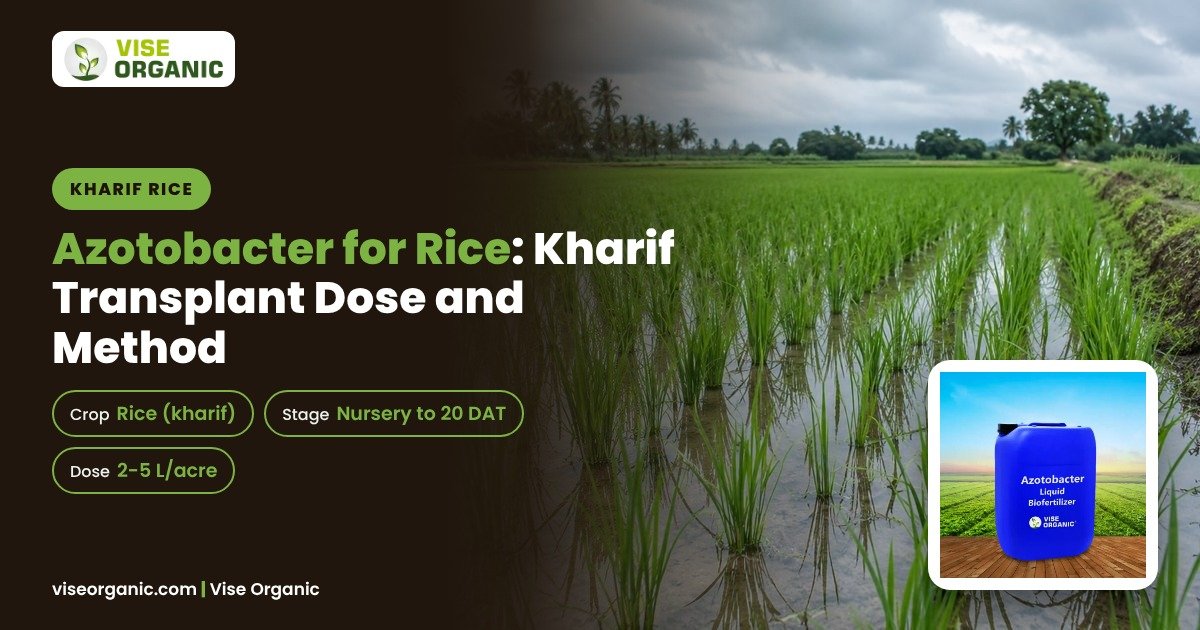
You have dipped the seedlings, kept the bed water up, and the crop looks fine at 20 days. Then the leaf tips go pale, the patch that got the last of the FYM stays green, and the rest of the field looks hungry. In most kharif rice fields I walk through between Junagadh and Bhavnagar, that pale green is not a missing bag of urea. The crop is sitting in water that is short of oxygen, and the free living nitrogen fixers you paid for are working slowly or not at all.
This guide covers Azotobacter for rice in kharif on transplanted fields: how much to use per acre, which method puts the cells where they actually survive, and the timing that gets value out of the 25 to 30 days your seedlings spend in the nursery. It is written for the standing water situation, because that is where most of the product gets wasted.
Why Rice Fields Waste Most of What You Apply
Azotobacter is a free living bacterium. It does not need a legume root to work; it lives in the film of water around soil particles and feeds on root exudates, the sugars and acids a living root leaks out. Give it food, moisture that is not sealed off from air, a pH between about 6 and 8 and a warm soil, and it multiplies in place.
A flooded rice field breaks two of those conditions at once. Standing water cuts the oxygen supply, so strict aerobes slow down sharply in the bulk soil. The active zone shrinks to a thin band around the root where the plant itself leaks oxygen. That is why broadcasting a full dose onto a puddled, flooded field on day 10 often shows nothing, and the same product used as a root dip shows a greener crop inside two weeks.
The fix is not to buy more. It is to place the cells in the root zone before the flood closes over them, and to feed them with organic matter so they have something to eat while they settle.
Reading Your Field Before You Open the Can
Before you decide anything, spend 20 minutes in the field. Take a spade of mud from two spots at 15 cm depth and smell it. Sour, rotten-egg smell means the soil is short of oxygen and full of reduced compounds; that is a placement problem, not a dose problem. Sweet, earthy smell means the microbial side is alive and you mostly need to keep it fed.
Then look at the water. Bright green scum on the surface tells you the bed or field is rich in free nitrogen already, usually from leftover FYM or an over-strong nursery dose. Algae compete with your crop for light and tell you to hold back on any nitrogenous input in the nursery.
If your field smells sour and the mud is grey and sticky, drainage does more for you than any additional dose. Read the wider Soil compaction signs and checks before you plan a second round.
The Four Placement Methods and Their Doses
Doses below are common published label ranges for liquid Azotobacter. Your own product label decides the number, and a local KVK or agronomist who knows your soil pH can narrow it down. Never exceed the label.
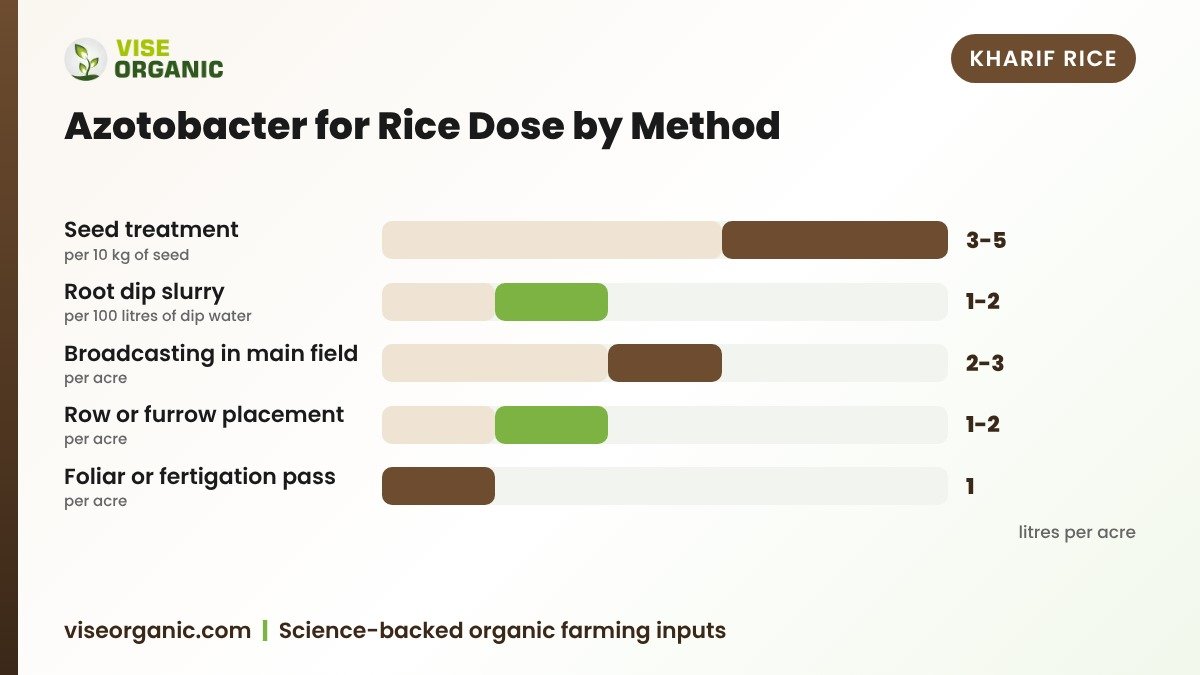
| Method | Dose (litres per acre) | Timing |
|---|---|---|
| Seed treatment | 3-5 | Per 10 kg of seed |
| Root dip slurry | 1-2 | Per 100 litres of dip water |
| Broadcasting in the main field | 2-3 | Per acre |
| Row or furrow placement | 1-2 | Per acre |
| Foliar or fertigation pass | 1 | Per acre |
Seed treatment and root dip put the cells directly on living tissue that will leak food for weeks. Broadcasting is the cheapest per acre and the least reliable, because the cells land on puddled mud and get buried by the next irrigation. Use broadcasting as a top-up, not as your only pass.
Our Liquid Azotobacter is sold for this kind of scheduling, and the Azotobacter Multiplier is the carrier you use when you want to bulk up a small can for a larger nursery.
A Week-by-Week Kharif Schedule
This is the sequence I would follow on a 3 to 5 acre transplanted plot in Saurashtra sown in late June, on the assumption that you transplant 25 to 30 days after sowing.
- Treat the seed 24 hours before sowing. Moisten 10 kg of seed with 3-5 litres of the culture plus enough jaggery water to hold it, spread on a gunny in the shade, and dry in shade for two hours. Never sun dry treated seed.
- Raise the nursery without algae. Keep the bed just moist, not ankle deep. A thin algae film means the bed is too rich; skip any further nitrogenous input there.
- Dip the roots on transplanting day. Mix 1-2 litres in 100 litres of mud-free water in a tub, bundle the seedlings, and hold the roots in for 10 to 20 minutes. Plant the same day; a dipped bundle left in the sun for four hours loses most of the benefit.
- Top dress 2 to 5 days after transplanting. Dilute 2-3 litres in 200 litres, mix with 25 kg of dry sand or well rotten FYM, and broadcast on moist soil in the evening after you have drained the standing water off.
- Repeat at 20 days after transplanting if the crop looks pale. Work it in during the weeding pass, when the soil is open and the roots are spreading.
- Optional late support at panicle to grain fill. A 1 litre foliar pass with jaggery and a spreader at dusk, only if the flag leaf is still pale and the soil is already fed.
In standing water, placement beats quantity: 2 litres on a living root outworks 5 litres thrown on puddled mud.
If you want the wider timing logic across crops, our When to apply biofertilizers for better crop results covers the same principle on other kharif crops.
What to Mix It With, and What Kills It
Azotobacter needs a carbon source in the root zone. That is the honest reason a humate or seaweed partner shows up in rice schedules: it feeds the microbial population and improves the soil around the roots where the cells have to survive.
- Well rotten FYM or compost. 1-2 tonnes per acre is the single biggest driver of a good response; see Compost maturity for soil health for how to tell whether your heap is actually mature.
- Humic acid granules. Eco Granule is worked into the puddling pass, which opens the root zone the cells live in.
- Potassium humate drench. Eco Root is the water soluble option for a root zone drench at transplanting.
- Seaweed or amino acid support. A light foliar pass of Seacure Liquid at tillering helps the crop hold its green when the soil is waterlogged.
- Crop specific nutrition. Nutri Rice is the rice position in our Nutri range for the tillering and panicle stages.
- Potash mobiliser. Where potash is locked in the soil, Potash Mobilizing Microorganism is the partner to use at the same top dressing.
What kills it: chemical fungicides and bactericides in the same tank, untreated chlorinated bore water, sun drying the treated seed or the dipped bundle, and applying on a hot dry mud surface at noon. If you must use a chemical seed treatment, do that first, let it dry, and treat with the biofertilizer the next day. For the water question, this Irrigation water quality and biofertilizer guide explains how to handle chlorinated sources.
When a Different Microbe Is the Better Call
Azotobacter fixes nitrogen from the air. It does nothing about locked phosphate or potash, and on some fields those are your real limits. A quick soil test settles it; Soil testing before biofertilizers shows which numbers to look at before you spend.
- P is low or your soil fixes phosphate hard. Use Phosphate Solubilizing Bacteria at the same pass; the PSB Multiplier stretches a small quantity across a bigger nursery.
- Soil pH is above 8. Free living nitrogen fixers work poorly in strongly alkaline soils. Acidify the root zone with organic matter first, and read the Soil pH farmer guide before buying another can.
- Potash is low on a rice-wheat rotation. KMB is the specialist there; see KMB biofertilizer for rabi and sugarcane potash.
- You are growing a pulse in the rotation, not rice. Use Rhizobium liquid biofertilizer on the legume instead; Azotobacter is not the right tool for nodulation.
- Soil carbon is your long-term limit. The Soil organic carbon guide for rabi wheat covers building the carbon base that makes every microbial input pay.
How to Judge Whether It Worked
Do not judge a microbial input by one leaf colour on day 12. Give it a fair test on your own land.
- Keep a check strip. Leave one corner or one long bund-to-bund strip untreated, same seed, same water, same fertilizer.
- Mark three dates. 15 days after transplanting for tiller count, panicle emergence for panicle length, and harvest for grain and straw weight.
- Count, do not guess. Ten random hills per spot, tillers counted and noted on paper. Colour photographs on the same day, from the same height, in the same light.
- Weigh the difference. Take the treated and untreated strips to the same threshing floor and weigh them separately.
- Write the number down. Next season you will have your own field's answer instead of somebody else's claim.
A good microbial product is a slow, compounding investment in soil life, not a quick green flash. Any response you see depends on your soil, variety, water and how the crop was managed, and a season where the field stayed flooded and cold may show very little even when the application was correct.
Safety, Storage and Label
- Wear gloves and a mask when opening cans and mixing slurry, and wash your hands before eating or smoking.
- Never tank mix with chemical fungicides or bactericides unless the label specifically allows it.
- Store cans in a cool dark shed, away from direct sun and heat, and never in a pesticide store.
- Keep cans closed and out of reach of children, and keep mixing tubs and leftover slurry away from drinking water sources and ponds.
- Check the batch date and count before buying; a liquid culture that has sat in a hot godown for a year is weak no matter what the label says.
- Read the label on your own pack for the exact dose, and confirm the plan with your local KVK or agronomist.
For bulk orders, dealers and FPOs, ask the supplier for the batch analysis certificate, the count at the time of packing, the packing condition of each can, and the printed manufacture and expiry dates before the truck is loaded. Check Our NPOP organic compliance page for what counts as an allowed input on a certified farm, since certifier rules, not a product claim, decide what you may use.
Frequently Asked Questions
What is the Azotobacter dose for rice per acre?
For liquid Azotobacter, common published ranges are 3-5 litres per 10 kg of seed for treatment, 1-2 litres per 100 litres of water for a root dip, and 2-3 litres per acre for broadcasting or top dressing. Your product label decides the exact number, so check it before mixing.
Can I broadcast Azotobacter on a flooded rice field?
Broadcasting onto standing water is the weakest method because the cells need oxygen and get buried by the next irrigation. Drain the water off, apply on moist soil in the evening, and mix the dose with sand or well rotten FYM so the cells stay near the surface and the roots.
Should I dip rice seedling roots or treat the seed?
Both work, and together they work best. Seed treatment carries the cells into the nursery, and a 10 to 20 minute root dip on transplanting day places them directly on roots that will leak food for weeks. Plant dipped seedlings the same day.
Can Azotobacter replace urea in rice?
No. Free living nitrogen fixers contribute a modest share of the crop's nitrogen, and how much depends on soil, water and organic matter. Follow your soil test and recommended fertilizer schedule, and use the biofertilizer as part of that plan, not as a substitute for it.
Can I spray Azotobacter with a fungicide?
Do not mix microbial products with chemical fungicides or bactericides in the same tank unless the label specifically allows it. If a chemical seed treatment is needed, apply it first, let the seed dry in shade, and treat with the biofertilizer the next day.
How do I know the Azotobacter I bought is still good?
Check the manufacture and expiry dates, buy cans that were stored in the shade rather than in an open godown, and look for the batch certificate on bulk orders. A liquid culture that has sat in heat for months is weak even if the expiry date is still ahead.
Which is better for rice, Azotobacter or PSB?
They do different jobs. Azotobacter fixes atmospheric nitrogen, while phosphate solubilizing bacteria make locked phosphate available. If your soil test shows low available phosphorus, use PSB in the same pass, and use Azotobacter for the nitrogen side.
Conclusion
Azotobacter for rice pays in kharif when the cells are placed on living roots before the flood closes over them, fed with organic matter, and topped up on moist soil rather than broadcast onto standing water. Treat the seed, dip the roots on transplanting day, and follow with 2 to 3 litres per acre at 2 to 5 days and again at 20 days, always against your own untreated check strip.
Browse Our products to see the microbial and humate range, and Contact Vise Organic or Request a callback for a dose plan matched to your soil test, water source and variety.
Disclaimer: This article is general agronomic information. Results vary with soil, crop, weather and practices. Always read and follow the product label and consult a local agronomist for advice specific to your field.
Article Topics & Tags:
Vise Agronomy Team
The in-house agronomy and field research team at Vise Organic Biotechnology, publishing applied research on bio-fertilizer protocols, crop protection, and sustainable cultivation practices.