
Winter in north India brings a familiar sight to a mustard field. You walk the rows on a cold December morning and your fingers come away sticky. The plants look green and tall enough, yet the shoots are curled and the leaves shine with honeydew. Half the time the damage you see was done two weeks earlier by a pest you never looked for. That is why mustard pest identification spray timing matters more than the number of sprays you finish.
This guide covers the four pests that do most of the damage in rabi mustard, how to tell them apart in the field in a minute or two, and the window in which a neem or botanical spray actually pays for itself. It also gives a scouting routine you can run without any special equipment, and a simple IPM calendar you can copy into your own farm diary.
Start With the Field Diary, Not the Spray Tank
Before anything else, write down the date of sowing, the variety and the field's growth stage. Every timing decision later depends on those three numbers, because the same insect is a nuisance at one stage and a real loss at another. A farmer in Bharatpur who sowed on October 20 reaches flowering about 55 days later, and that single date tells him when to start checking buds.
Carry a phone or a small notebook and note the location of every infested patch instead of treating the whole field by habit. Patch treatment protects the beneficial insects that live on the field edges, and it keeps your spray cost down. Our Mustard IPM spray calendar covers the full season nutrition alongside this; here the focus is protection alone.
The Four Pests That Matter in Rabi Mustard
Learn these four and you have covered most of what you will meet between December and February. Each leaves a different signature on the plant, so a careful look at one plant tells you which one to hunt for.
- Mustard aphid. Small green to black insects crowd the underside of young leaves and the growing point, curl the leaves, and leave sticky honeydew that later turns black with sooty mould. Ants marching up and down the stems are a reliable giveaway.
- Diamondback moth. Tiny green caterpillars feed from the underside and leave windows, where only the thin upper skin of the leaf is left. Look for them hanging on a silk thread when you shake the plant, and for pupae wrapped in a loose cocoon.
- Sawfly. Chunky pale green grubs with dark heads strip leaves from the margins and fall to the ground when disturbed. Frass pellets under the plant collect quickly during a warm spell in late January.
- Stem borer. The first sign is a shot hole with frass near a node, then a hollow stem that snaps in the wind. A plant with a damaged central shoot in a stand that is otherwise uniform points to early borer entry.
The 3-4 Day Scouting Walk
Pest numbers in mustard rise and fall with the weather faster than most sprays take to work, so the schedule of looking matters as much as what you spray. Walk a zig-zag across the field and stop at ten plants at four or five spots, keeping well away from the boundary rows.
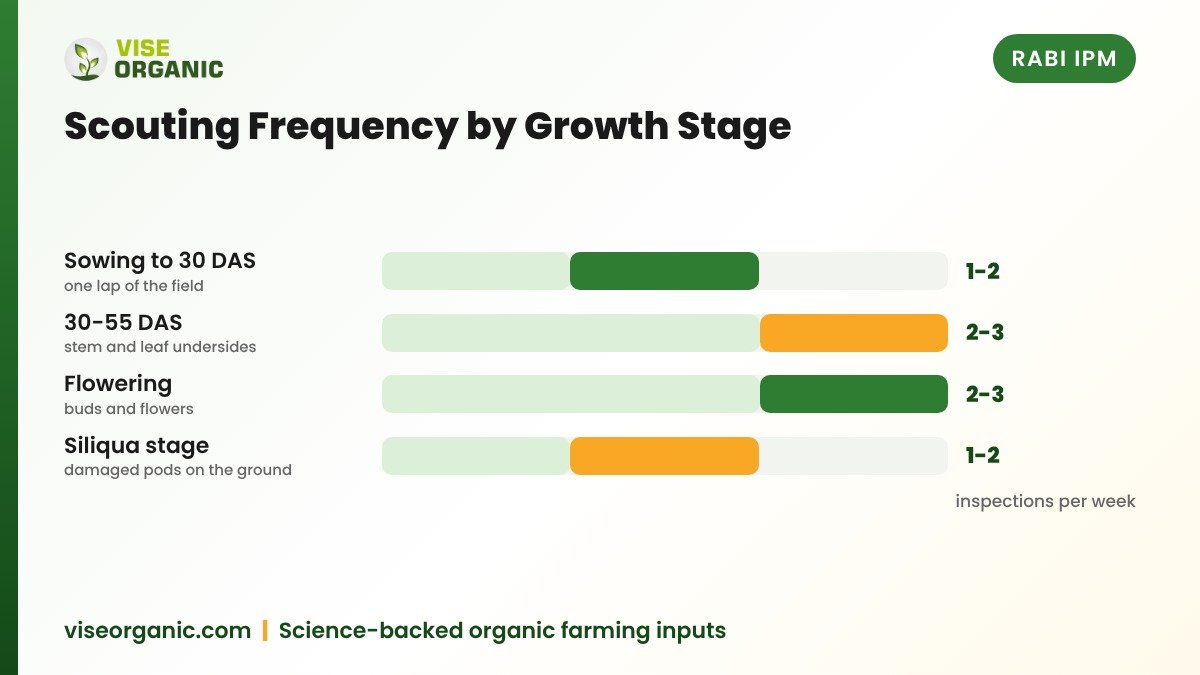
One lap of the field is enough up to a month after sowing. Between 30 and 55 days after sowing, increase to two or three inspections a week and turn every leaf you touch, because this is the window in which aphid colonies establish. At flowering, open five buds per plant; small caterpillars hide inside them. At the siliqua stage, look at the ground under the plant for fallen grubs and clipped pods.
Weather Decides Whether a Pest Outbreak Happens
Cold and rain break insect build-up, while a dry, warm spell with high nitrogen pushes it up. This is the reason two fields ten kilometres apart can need very different handling in the same week.
- Warm and dry. Aphid colonies can double within days. Check twice a week and be ready to act at the first sign of curling.
- Rain or heavy dew. Fungal disease risk rises and insect build-up usually slows. Hold off on sprays and watch for leaf spots instead.
- Nitrogen-heavy, lush crop. Soft succulent growth attracts aphids. Balanced nutrition makes the crop stand up better, as covered in our guide to Balanced nutrition for mustard.
- Wind from stubble fields. Aphids arrive from harvested wheat and vegetable fields. Check the side of your field that faces that wind first.
When a Botanical Spray Earns Its Cost
A botanical spray is a population management tool, not a knockdown. It works best when pest numbers are rising but the crop has not yet lost the leaf area or buds that will become yield. Spray at the stage where the pest feeds, and spray the part of the plant where it sits.
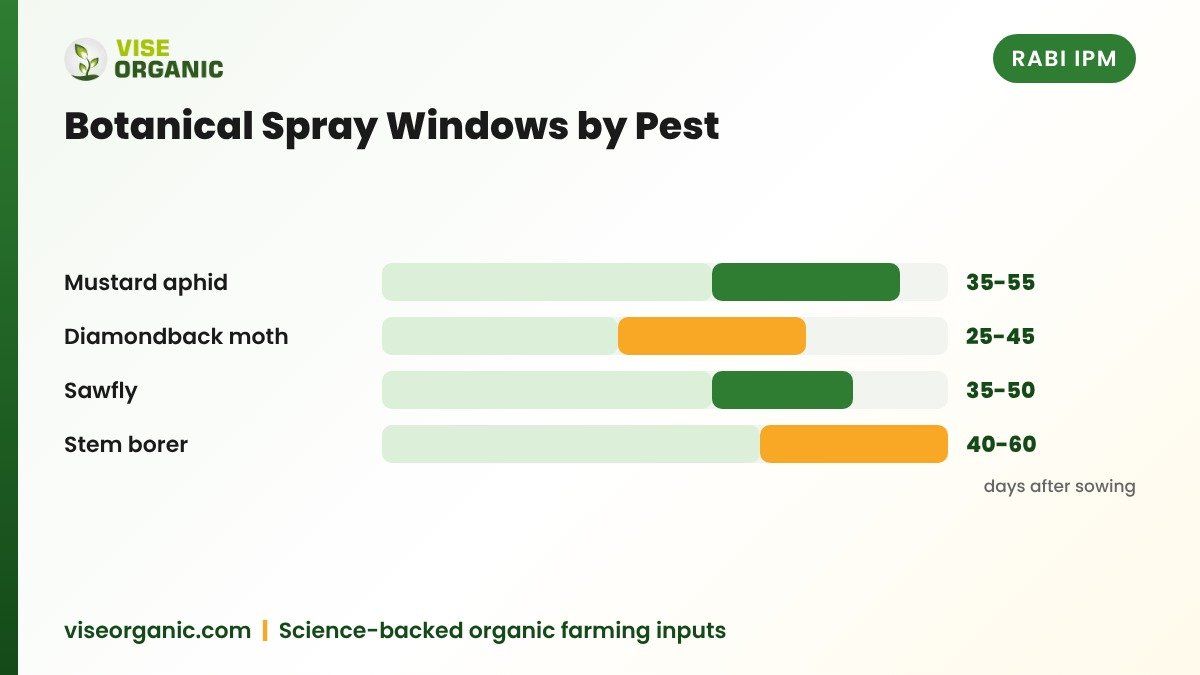
Neem-based products act mainly as an antifeedant and growth disruptor, so the pest must pick them up while feeding. That means coverage matters far more than dose. A tank mixed too thin to wet the leaf underside does nothing, and a heavy drench at the wrong stage wastes money. For the aphid window specifically, see our notes on Mustard aphid control spray timing and Bitter gourd fruit fly botanical spray timing for the same timing logic on a different crop.
- Set the threshold. Decide the number at which you will act, such as colonies on one in four plants, and write it in your diary before the pest appears.
- Spray in the cool hours. Work between 7 and 10 in the morning or after 4 in the afternoon; winter dew and midday heat both cut coverage.
- Aim at the pest's seat. Tilt the lance upward for leaf undersides and open buds rather than spraying the top of the canopy.
- Use a spreader on waxy leaves. Mustard leaves and pods are waxy, so a proper spread adjuvant such as Plant Stick improves spread and coverage.
- Spot-treat the patches. Where only 20 to 30 percent of the field is infested, spray those patches well and leave the rest for natural enemies.
- Wait before judging. Read the label for the re-inspection interval, then check the same marked plants again rather than spraying on feeling.
In mustard, the day you find the pest matters less than the stage the crop is at when you find it.
Microbial Biopesticides for the Harder Patch
When caterpillar numbers keep climbing despite a botanical spray, a microbial product fits the rotation better than another botanical round. Eco Cover is our botanical and organic pesticide line for chewing and sucking pests, Eco Safe covers the disease side when leaf spots appear alongside insect damage, and Virexx is the option where a virus problem shows up in the crop. Rotate the mode of action between rounds instead of repeating one product three times in a row, and keep the crop's own allies in mind while doing so. What strategies do organic farmers use for effective pest management explains that rotation logic, and Natural pest and disease management covers the basics of identification.
Build the Season Calendar on Paper
A calendar written before December stops most panic sprays. Sit down one evening and mark your sowing date, then count forward to the four windows in the table above.
- Mark your sowing date and count 30, 45 and 55 days forward to get your scouting start and the two peak windows.
- Fix your thresholds in writing, plant-based rather than area-based, so a decision does not depend on your mood that day.
- Book the inputs you will need, the botanical product, a spreader, and nozzles that give a fine even spray.
- Plan two rotations, one botanical round and one microbial round, so you are never forced to repeat the same product.
- Set a diary reminder for every 3 to 4 days between 30 and 55 days after sowing.
- Note the harvest date target for your variety and work backwards to leave a safe gap from the last spray.
Safety and Label
Read the full label before mixing anything, including botanical and microbial products, and follow the crop, dose, pre-harvest interval and number of allowed sprays printed there. Wear gloves and a mask while mixing and spraying, and wash hands and clothes after the job. Do not tank-mix a microbial product with a chemical fungicide or bactericide unless the label clearly permits it, and never spray near a pond, well or canal bank. Store packs in a cool shaded place away from direct sun and heat, sealed and out of reach of children and animals. Empty packs go to a collection point, never burnt or dumped on the field bund.
Frequently Asked Questions
How often should I scout my mustard field in rabi?
Walk the field every 3 to 4 days between 30 and 55 days after sowing, when aphid and diamondback moth populations build fastest. Before 30 days and after flowering begins, one careful inspection a week is usually enough, with extra visits after a warm dry spell.
How do I tell aphids from diamondback moth damage?
Aphids sit in crowds on the underside of young leaves and the growing point, leave sticky honeydew and attract ants, and curl the leaf. Diamondback moth caterpillars make transparent windows in the leaf and drop down on a silk thread when you shake the plant. Sticky hands and black sooty mould point to aphids; skeletonised leaves point to the moth.
What is the best time of day to spray botanical products on mustard?
Spray in the cool, dry hours, between 7 and 10 in the morning after the dew has dried or after 4 in the afternoon before dew returns. Winter dew dilutes the spray and midday heat dries the droplet before the pest picks it up. Do not spray if rain is expected within the label's rainfast period.
Can I mix neem oil with a microbial biopesticide in the same tank?
Check both labels first. Many botanical products are not compatible with microbial formulations in the same tank, and mixing with a chemical fungicide or bactericide usually harms the microbes. The safer practice is to alternate them across sprays, with the interval the labels advise.
Does a botanical spray kill pests the same day?
No. Botanical products such as neem work mainly by stopping feeding and disrupting growth, so you should see reduced damage over a few days rather than a knockdown. Judge the result by re-checking the same marked plants after the interval on the label, not by looking the next evening.
My mustard plants have shot holes and snap in the wind. What is happening?
That pattern points to stem borer. Look for frass pushed out near a node and split a few snapped stems to confirm a hollow centre. Treat the affected patches early in the window before more entry holes appear, rogued damaged plants, and keep the field free of alternate weed hosts.
Are these products allowed on certified organic mustard?
What is permitted on a certified organic farm is decided by NPOP or your certifier's input list, not by a product being botanical. Confirm the specific product with your certifier and read the label before using anything on a certified block.
Conclusion
Getting mustard pest identification spray timing right is mostly a matter of looking often enough and knowing which of the four pests you are looking at. Scout every 3 to 4 days between 30 and 55 days after sowing, match the pest to its window, and let the crop stage rather than the calendar date decide the spray. Rotate a botanical round with a microbial one, always spray the part of the plant where the pest actually feeds, and keep records so next season's calendar is better than this one.
Explore the protection range in Our shop and Contact Vise Organic for a schedule matched to your district and variety, or Request a callback to speak with our crop advisory team.
Disclaimer: This article is general agronomic information. Results vary with soil, crop, weather and practices. Always read and follow the product label and consult a local agronomist for advice specific to your field.
Article Topics & Tags:
Vise Agronomy Team
The in-house agronomy and field research team at Vise Organic Biotechnology, publishing applied research on bio-fertilizer protocols, crop protection, and sustainable cultivation practices.