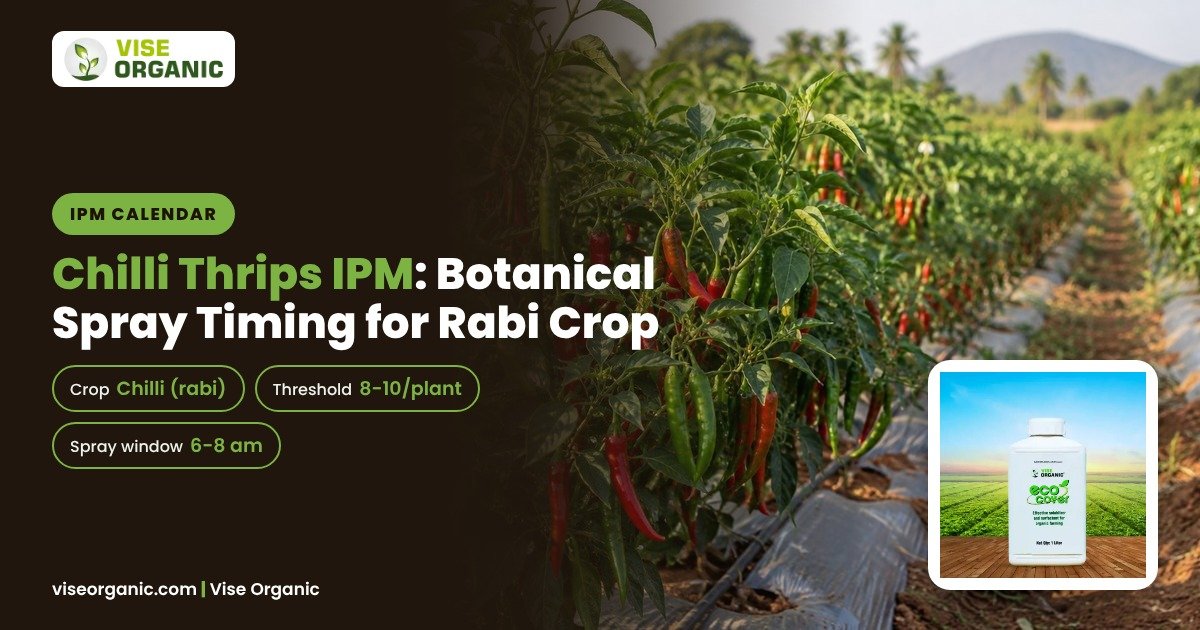
You walk into a rabi chilli field in late November and the top leaves look silvery, as if someone rubbed powder over them. Rub a leaf over white paper and two or three slender insects drop off. That is thrips, and in Guntur, Nalgonda, Krishi Bhagath style belts across Andhra, Telangana and Karnataka it decides most of your harvest from flowering onward. Getting chilli thrips IPM right is not about spraying more often. It is about scouting on a fixed day, spraying at the right hour, and rotating the right botanical and microbial products so the population never gets a free run.
This guide covers one crop and one pest: how to identify thrips damage against the look-alikes, where the action threshold sits, and a week-by-week spray calendar for rabi chilli from transplant to first pick. Botanical sprays do the knockdown work, microbial biopesticides hold the population down between sprays, and the calendar keeps you off the calendar-driven spray habit that breeds resistance.
Read the Silvering Before You Spray
Thrips hide inside the leaf folds and flower buds, so the damage tells you more than a quick glance. Raking by the feeding style leaves air-filled cells that read as silver patches in full sun.
Look for these signs together, not one alone:
- Silvery streaks. Long narrow patches along the veins of young leaves that shine in midday sun.
- Curled leaf margins. New leaves twist inward and the plant looks stunted at the growing point.
- Black flecks. Tiny dark specks of frass near the leaf axils and inside bud clusters.
- Scarred flowers. Buds turn yellow and drop, and open flowers show brown scars at the base.
Confirm it by tapping a young leaf over a white sheet of paper. Thrips are 1 to 2 mm, pale yellow to brown, with fringed narrow wings. Under a hand lens you will see them move fast sideways. If the paper shows tiny hopping insects with a pinched waist instead, you have aphids and the approach changes; our Mustard aphid control spray timing guide covers that pest in detail.
Set Your Action Threshold
Spraying on a fixed date wastes money and speeds up resistance. Count instead. Walk a W-shaped route across the field, five to ten plants at each of five points, and count thrips on the third and fourth true leaves plus the flower buds.
For chilli, most state agricultural universities and KVK advisories treat 8 to 10 thrips per plant as the point to act in a flowering crop. Below that, natural enemies and one good botanical drench usually hold it. Above 15 per plant with visible silvering on new growth, one spray alone will not finish the job and you should plan a follow-up in 5 to 7 days.
Spray when the count crosses the threshold and the hour is right. A correct spray at 7 in the morning beats three correct products sprayed at noon.
Why Spray Hour Matters More Than Product
Thrips stay deep in the bud and on the underside of leaves during hot hours, and they come out to feed in low light. That is your window.
- Early morning, 6 to 8 am. Best window. Humidity is high, thrips are active on the surface, and botanical sprays dry slowly enough to be taken in.
- Evening after 4:30 pm. Second-best window, useful when the morning is busy. Thrips return to the surface as light drops.
- Midday, 11 am to 3 pm. Avoid. Neem and botanical sprays dry too fast, coverage is wasted, and leaf burn risk rises on hot dry days.
Aim for 150 to 200 litres of water per acre on a flowering chilli crop, more as the canopy closes. Fine droplets beat heavy drenching, because the chemical has to reach inside the bud.
The Botanical Layer for Knockdown
Botanical sprays act on contact and by disrupting feeding and moulting. They have short residual life, which is a strength for resistance management and a weakness on a high-pressure field. This is where Neem oil earns its place in chilli thrips IPM.
Two points people get wrong. First, neem oil is not a quick knockdown. It works over 3 to 5 days by stopping feeding and moulting, so counts must be judged on day 5, not the next morning. Second, an oil needs a spreader to sit inside a bud. A spread sticker such as Plant Stick at label rate improves coverage on waxy chilli leaves.
For a fast knockdown on high counts, a botanical mixture from the Vise Organic range such as Eco Cover at the label dose gives contact action that neem alone does not. Follow the label on the pack for the exact dose for chilli, and ask your local KVK what is recommended in your district this season.
The Microbial Layer for the Gap Weeks
Microbial biopesticides work slowly and keep working. Where a botanical spray hits the adults in front of you, a microbial product infects the population that is still hidden. Use them between botanical sprays, not mixed with them.
Two rules that matter more than the brand. Do not tank-mix microbial insecticides with chemical fungicides or bactericides unless the label clearly allows it, because those products kill the microbe you paid for. And keep the spray tank clean: rinse a tank that held a chemical fungicide three times before using it for a microbial product.
For virus pressure in chilli, which thrips spread, a virus controller such as Virexx fits into the schedule at the first symptom stage. Our Virexx sustainable pest management article explains how it sits in a programme. For the fungal side of a wet rabi, Eco Safe covers anthracnose and fruit rot, and it is worth reading How Eco Safe contributes to pest and disease management before you plan tank mixes.
Weekly Rabi Chilli Spray Calendar
Timings below assume transplant in October or early November, normal December flowering, and counts crossing the threshold. If counts stay below 8 per plant, skip that week's spray and spray only the field borders.
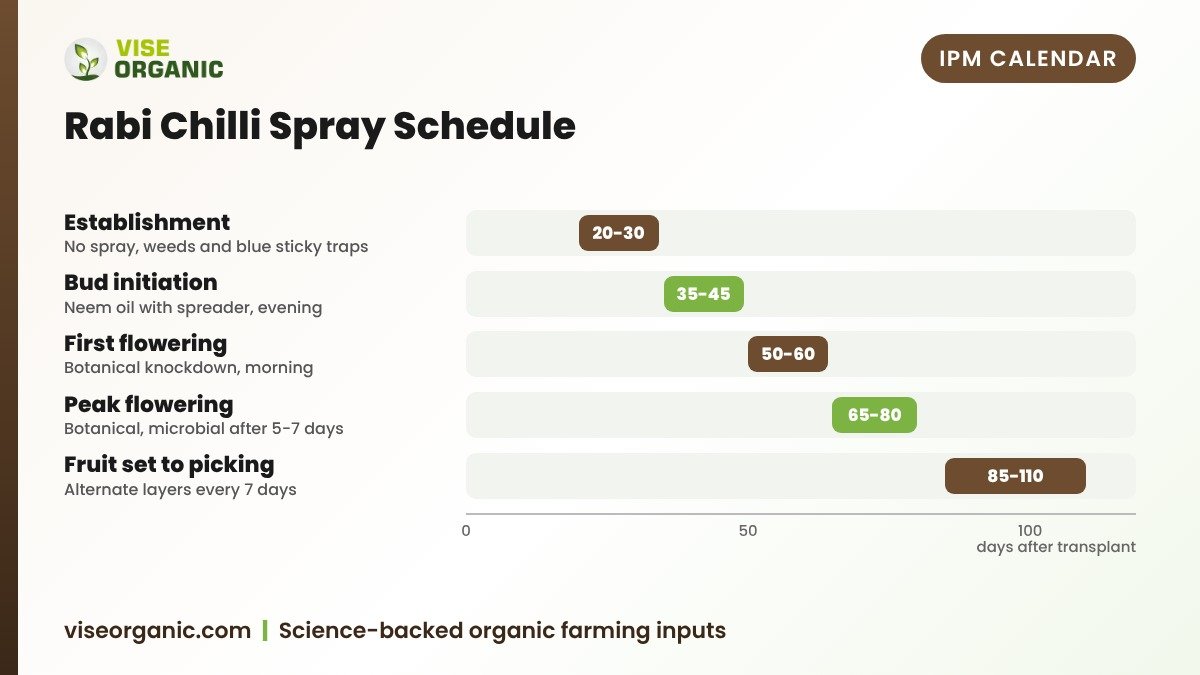
The same information as a schedule, so nothing is lost if the chart is all you see: at establishment, 20 to 30 days after transplant, with 0 to 5 thrips per plant, do not spray at all, only remove weeds and put blue sticky traps at crop height. At bud initiation, 35 to 45 days, on 5 to 8 thrips, apply neem oil at label rate with a spreader in the evening. At first flowering, 50 to 60 days, on 8 to 10 thrips, use a botanical knockdown in the early morning. At peak flowering, 65 to 80 days, on 10 to 15 thrips, follow the botanical with a microbial product after 5 to 7 days. From fruit set to picking, 85 to 110 days, above 15 thrips, alternate botanical and microbial every 7 days and respect the pre-harvest interval on the label.
Scouting and Trap Routine That Saves Sprays
A calendar without scouting is guesswork. Fix the routine so it takes twenty minutes a week.
- Hang traps at day 20. Blue sticky traps at crop height, 8 to 10 per acre, checked every Monday.
- Count on the same day. Five points in a W route, ten plants each, third and fourth true leaves plus buds.
- Write the number down. Keep a notebook in the field. Compare with last week before deciding.
- Check the hour and weather. No spray before rain within 4 hours, no spray above 35 degrees C.
- Judge on day 5. Count again five days after any spray, not the next morning.
- Change the layer, not just the bottle. If the same botanical failed twice, move to the microbial layer next.
Rotate actives across generations rather than across days. Two sprays of the same product in one generation is where field-level control starts failing.
Nutrition That Keeps the Crop Tolerant
A crop with thick cell walls and steady growth shows less silvering for the same thrips load. Excess nitrogen makes soft leaf tissue that thrips prefer, so avoid top-dressing urea just before flowering.
Seaweed and humate products support steady growth and root recovery during the cool stress of December. Seacure Liquid as a foliar feed at label rate, or Eco Green at the root, fit into the same week as a microbial spray. For fruit quality in a picking crop, our guide to Bitter gourd fruit fly botanical spray timing shows the same principle of pairing nutrition with a botanical, and the Bacterial pathogen spray timing article covers the spray-timing logic for bacterial fruit rot that thrips wounds invite.
Safety and Label
Microbial and botanical does not mean careless. Read the label on every pack before the first mix, including the pre-harvest interval for a picking crop, which can be 3 to 7 days.
- Wear gloves and a mask or clean cloth over nose and mouth while mixing and spraying.
- Do not mix microbial biopesticides with chemical fungicides or bactericides unless the label allows it.
- Mix only what the tank needs and spray the same day. Microbial products do not sit in a tank overnight.
- Store packs in a cool dry place away from direct sun and heat, and never near food.
- Keep the spray tank and mixing area away from children, animals and any water body or well.
- Wash hands and change clothes after spraying. Clean the tank three times before switching product types.
If you are buying for a grower group or an FPO, check the batch certificate and content declaration, the manufacturing and expiry dates, and the packing seal before the lot is accepted. Store received stock in a shaded, ventilated godown off the floor, first lot in first lot out, and keep the batch records so you can trace any spray back to a lot. Organic certification buyers will ask for this, and NPOP and certifier rules decide what is allowed on a certified farm, so check with your certifier rather than assuming.
Frequently Asked Questions
How many thrips per chilli plant mean I should spray?
In a flowering rabi chilli crop, 8 to 10 thrips per plant is the usual action point in most KVK and state advisories. Below that, traps, sanitation and one botanical spray usually hold it. Above 15 with fresh silvering on new leaves, plan a follow-up in 5 to 7 days rather than one heavy spray.
What is the best time of day to spray for thrips?
Early morning between 6 and 8 am, or evening after 4:30 pm. Thrips hide inside buds and under leaves in bright heat and come out in low light. A correctly timed morning spray gives better bud coverage than a midday spray with a stronger product.
Can I mix neem oil with a microbial biopesticide in the same tank?
Do it only if both labels allow it. Neem oil is a contact botanical and microbial products need to reach and colonise the pest, so tank mixing often reduces the microbial effect. The safer route is neem in one spray and the microbial product 5 to 7 days later.
How long before neem oil shows results on chilli thrips?
Judge neem on day 5, not the next morning. It works mainly by stopping feeding and moulting, so counts fall gradually. If counts are still above threshold on day 5, switch to the microbial layer rather than repeating the same oil.
Are blue or yellow sticky traps better for chilli thrips?
Blue is more attractive to thrips and is the usual choice for monitoring them, placed at crop height, 8 to 10 per acre. Yellow traps catch whitefly and other pests too, so many growers use both to separate which pest is actually building up.
Can I use chemical fungicide and a microbial spray together in chilli?
Usually not. Chemical fungicides and bactericides can kill the microorganism in a microbial biopesticide. If a fungicide spray is needed, leave a gap of several days and rinse the tank three times before the microbial spray, unless the label states otherwise.
What is the pre-harvest interval for botanical sprays in a picking crop?
It varies by product, commonly 3 to 7 days, and the label is the only reliable source. In a chilli crop where you pick every 4 to 5 days, plan sprays right after a pick so the interval runs on the days before the next pick.
Conclusion
Chilli thrips IPM comes down to three habits: count on a fixed day, spray in the low-light window, and alternate the botanical knockdown layer with the microbial holding layer instead of repeating one bottle. Work the calendar against your own counts, judge results on day 5, and keep nutrition steady so the crop is not the softest target in the village.
Browse Our products for the botanical, microbial and nutrition lines used above, or Contact Vise Organic to talk through your district's pressure pattern. For crop-specific advice on your field, Request a callback and our agronomy team will help you build the schedule.
Disclaimer: This article is general agronomic information. Results vary with soil, crop, weather and practices. Always read and follow the product label and consult a local agronomist for advice specific to your field.
Article Topics & Tags:
Vise Agronomy Team
The in-house agronomy and field research team at Vise Organic Biotechnology, publishing applied research on bio-fertilizer protocols, crop protection, and sustainable cultivation practices.