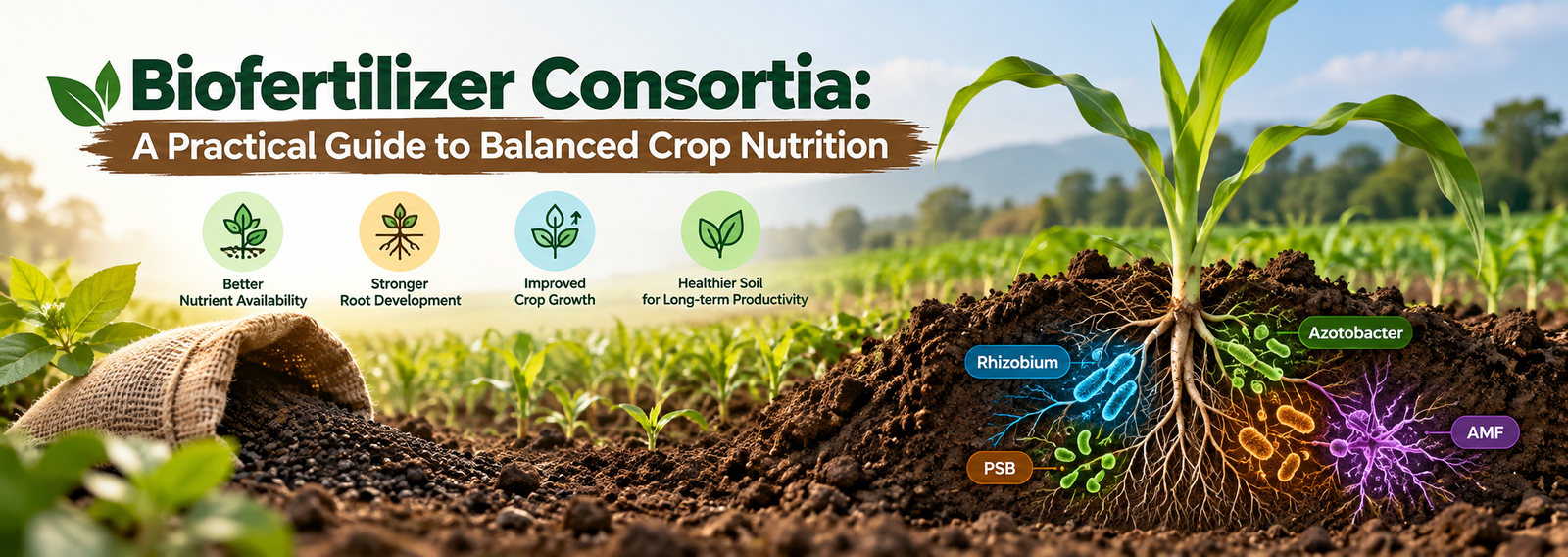
Balanced crop nutrition is not only about adding more fertilizer. It is also about helping plants access nutrients that are already present in the soil and rhizosphere. Biofertilizer consortia bring together compatible beneficial microorganisms so that several nutrient functions can work side by side, including biological nitrogen fixation, phosphate solubilization and potassium mobilization.
For farmers looking to strengthen nutrient-use efficiency while supporting long-term soil health, microbial inputs can be a useful part of an integrated nutrient-management program. They should be selected for the crop, soil conditions and application method, and used according to product labels and local agronomic recommendations.
What is a biofertilizer consortium?
A biofertilizer consortium is a formulation containing two or more compatible beneficial microorganisms. Instead of relying on a single microbial function, a well-designed consortium can combine organisms that contribute to different parts of crop nutrition.
For example, an NPK-focused microbial program may combine:
- Nitrogen-fixing microorganisms such as Azotobacter, which can contribute biologically fixed nitrogen in the root zone.
- Phosphate-solubilizing bacteria (PSB), which can help convert some poorly available soil phosphorus into forms that plants can access more readily.
- Potassium-mobilizing microorganisms (KMB), which can help improve access to certain soil potassium pools.
ICAR has also developed microbial NPK consortium technologies built around these complementary functions, illustrating how multi-strain biological inputs are being used in practical nutrient-management systems.

How nitrogen, phosphorus and potassium microbes complement each other
1. Nitrogen fixation
Nitrogen is essential for vegetative growth, chlorophyll formation and many plant metabolic processes. Free-living nitrogen-fixing bacteria such as Azotobacter can convert atmospheric nitrogen into biologically useful forms within the soil ecosystem. Their contribution varies with crop, soil, moisture, organic matter and management conditions.
Vise Organic's Azotobacter Liquid Based is one option for farmers building a biological nutrient-management program around nitrogen-fixing microorganisms.
2. Phosphate solubilization
Soils may contain phosphorus that is chemically bound and not readily available to roots. Phosphate-solubilizing bacteria release organic acids and other compounds that can increase the solubility of some phosphorus compounds in the rhizosphere.
For this function, see Vise Organic's Phosphate Solubilizing Bacteria.
3. Potassium mobilization
Potassium supports water regulation, enzyme activity and many physiological processes in crops. Potassium-mobilizing microorganisms can help release or mobilize potassium from certain mineral sources in soil, improving its accessibility around roots under suitable conditions.
Vise Organic's Potash Mobilizing Microorganism can be considered where a K-mobilizing biological input fits the farm's nutrient plan.
Why use a multi-microbe nutrient strategy?
The main advantage is functional diversity. A compatible combination of beneficial microbes can address more than one nutrient pathway at the same time. That does not mean every strain automatically works well together, or that biofertilizers completely replace crop nutrition inputs. Compatibility, viable cell count, storage, soil conditions and application timing all matter.
| Microbial function | Nutrient focus | Practical role |
|---|---|---|
| Nitrogen fixation | Nitrogen | Supports biological nitrogen input in the rhizosphere |
| Phosphate solubilization | Phosphorus | Helps make some fixed phosphorus more available |
| Potassium mobilization | Potassium | Helps mobilize certain soil potassium pools |
Where biofertilizer consortia fit in integrated nutrient management
Microbial inputs are best treated as one component of a broader fertility strategy. Soil testing, crop nutrient demand, organic matter management, irrigation, pH, fertilizer placement and microbial inoculants all interact. In many cases, the goal is better nutrient-use efficiency and stronger biological activity rather than simply eliminating conventional inputs overnight.
A practical program may combine soil-test-based fertilizer decisions with biological inputs, compost or organic matter, crop residues and good irrigation management. This gives beneficial microbes a more favorable environment while keeping crop nutrition aligned with realistic yield targets.

Application planning: what farmers should check
Before applying any microbial biofertilizer, check the product label and agronomic recommendation for the specific crop. Important considerations include:
- Crop and growth stage
- Seed treatment, root dip, soil application or drip compatibility
- Soil moisture and temperature
- Compatibility with pesticides, fertilizers and other tank-mix partners
- Storage conditions and expiry date
- Required dose and timing
Living microbial products can lose effectiveness when exposed to unsuitable heat, direct sunlight or incompatible chemicals. Good handling is therefore as important as product selection.
Biofertilizer consortium vs single-strain biofertilizer
A single-strain product is useful when a farm has a specific biological objective, such as phosphorus solubilization. A consortium is attractive when several complementary functions are needed in one program. The better choice depends on soil conditions, crop needs, formulation quality and whether the organisms are proven to remain compatible and viable together.
For farms that prefer a broader nutrient approach, Vise Organic also offers Liquid NPK. Product choice should still be based on the label, crop requirement and local agronomic guidance.
Frequently asked questions
Can biofertilizer consortia replace chemical fertilizers completely?
Not automatically. Their role is generally to support biological nutrient cycling and nutrient availability. Fertilizer requirements should still be determined from crop demand, soil testing and local recommendations.
Are NPK microbial consortia suitable for every crop?
Suitability depends on the organisms in the formulation, the crop, soil conditions and the registered or recommended uses of the product. Always follow the product label.
Can Azotobacter, PSB and KMB be used together?
These functions are commonly combined in microbial nutrient-management programs, but compatibility should be established for the specific formulation or application plan rather than assumed for every product combination.
When is the best time to apply biofertilizers?
Application timing depends on the product. Common approaches include seed treatment, seedling or root treatment, soil application and irrigation-based application. Refer to the specific label for the correct method.
Why is soil moisture important?
Beneficial microorganisms need a suitable root-zone environment to establish and remain active. Excessively dry or otherwise stressful conditions can reduce microbial performance.
How should microbial biofertilizers be stored?
Follow the manufacturer's storage instructions. In general, microbial products should be protected from excessive heat, direct sunlight and conditions that reduce organism viability.
Build balanced crop nutrition from the soil upward
Biofertilizer consortia provide a practical way to bring multiple beneficial microbial functions into crop nutrition. Nitrogen-fixing, phosphate-solubilizing and potassium-mobilizing microorganisms each address a different part of nutrient availability, and together they can complement an integrated fertility program.
Explore Vise Organic's biological crop-nutrition solutions, including Azotobacter Liquid Based, Phosphate Solubilizing Bacteria, Potash Mobilizing Microorganism and Liquid NPK, and choose the program that matches your crop and soil needs.
Technical note: ICAR describes NPK microbial consortium technologies that combine nitrogen-fixing, phosphate-solubilizing and potassium-mobilizing microorganisms for integrated crop nutrition. Field performance varies by formulation, crop and growing conditions.